
What Is the Training Balance Scale? Kevin Trudeau’s 90/10 Rule Explained
Why can one person take enormous amounts of action and still feel as though they are getting nowhere?
And why can another person appear to take fewer actions yet make steady progress toward a goal?
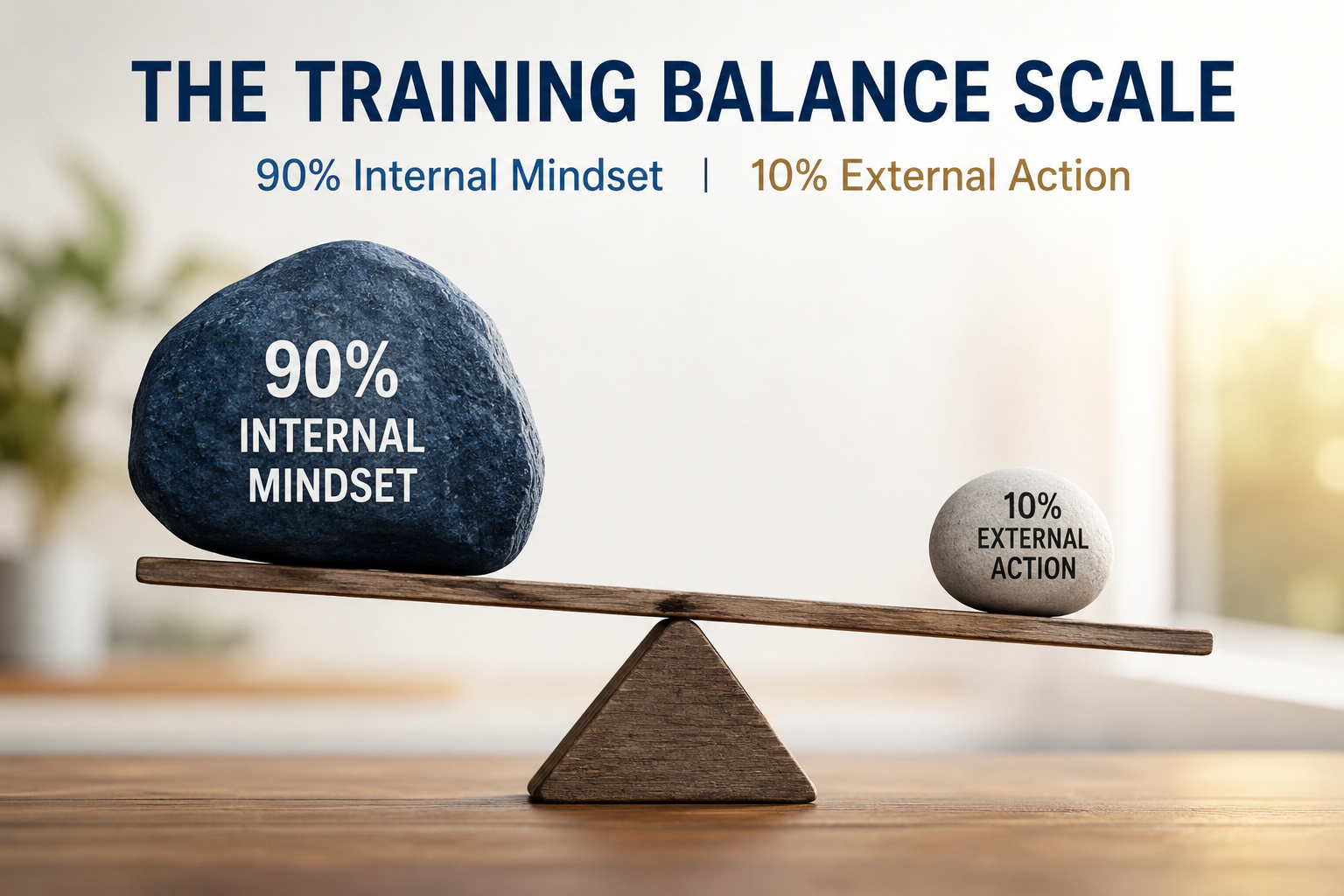
Kevin Trudeau addresses this question through a concept he calls the Training Balance Scale.
The Training Balance Scale is one of the foundational ideas taught in Your Wish Is Your Command.
According to Trudeau’s framework, people often concentrate almost entirely on external action while paying far less attention to their beliefs, expectations, emotional state and internal preparation.
He presents the balance differently:
• approximately 90% internal work
• approximately 10% external action
That does not mean action is unnecessary.
It means Trudeau argues that the quality and effectiveness of your actions may be influenced by the internal state from which you take them.
This independent KevGuru guide explains what the Training Balance Scale means, how the 90/10 idea works, how it connects with the Teachability Index, where it may offer useful practical insight, and why the 90/10 ratio should be understood as a personal-development framework rather than a scientifically established law.
Recommended KevGuru Resources
Table of Contents
1. What Is the Training Balance Scale?
The Training Balance Scale is Kevin Trudeau’s framework for thinking about the relationship between internal preparation and external action.
In his teaching, the internal side includes things such as:
• mindset
• beliefs
• expectations
• emotional state
• self-image
• internal confidence
• visualization
• counter-intentions
• what he describes as energy or vibration
The external side includes things such as:
• making calls
• sending emails
• attending meetings
• applying for opportunities
• launching a business
• practising a skill
• following a plan
• taking physical action toward a goal
Kevin Trudeau teaches that many people reverse the balance.
They may spend almost all their time doing more while paying relatively little attention to the beliefs and thought patterns influencing what they do.
His Training Balance Scale therefore gives much greater emphasis to internal preparation before external execution.
2. What Does the 90/10 Rule Mean?
Kevin Trudeau describes the Training Balance Scale using an approximate 90/10 ratio.
His teaching places:
90% on internal alignment and preparation
and
10% on physical action and external strategy.
This should not be interpreted as a mathematical formula proving that exactly 90% of every result comes from your thoughts.
It is better understood as a teaching device.
The purpose of the ratio is to make a point:
People often focus heavily on what they are doing while paying much less attention to the beliefs, expectations and emotional patterns influencing those actions.
For example, someone could spend hours contacting potential customers.
But if they expect rejection, lack confidence in what they are offering and communicate uncertainty, the quality of those conversations may suffer.
The external action still matters.
But the internal state may affect how effectively the action is performed.
That is the practical idea behind the 90/10 distinction.
3. What Counts as the Internal 90%?
The internal side of the Training Balance Scale is broader than simply “thinking positively.”
Within Your Wish Is Your Command, Kevin Trudeau connects internal preparation with several areas.
These include your beliefs about what is possible, your expectations about what will happen, the emotional state you repeatedly operate from, your self-image and what he calls counter-intentions.
A counter-intention is the idea that you may consciously want one result while another belief or pattern works against it.
For example:
You may consciously want to build a business but believe that selling is dishonest.
You may want a better relationship but expect people eventually to disappoint you.
You may want to become financially secure while believing that wealthy people are selfish.
Whether or not you accept Trudeau’s broader explanation of subconscious programming, these examples illustrate a practical point.
Conflicting beliefs can influence behaviour.
Someone who expects failure may hesitate.
Someone who expects rejection may avoid asking.
Someone who believes success will create problems may repeatedly delay important decisions.
The internal side of the Training Balance Scale encourages you to examine those influences before assuming that the solution is simply to work harder.
4. What Counts as the External 10%?
The external 10% represents the actions you physically take.
This includes the practical work required to move toward a goal.
If you want a new job, action might include:
• improving your résumé
• applying for positions
• contacting employers
• attending interviews
• developing additional skills
If you want to build a business, action may include:
• creating an offer
• speaking with customers
• marketing
• making sales
• improving the product
• managing finances
If you want to improve a relationship, action may include:
• listening more carefully
• communicating clearly
• spending meaningful time together
• changing repeated behaviours
The Training Balance Scale does not remove the need for these actions.
In fact, without action, many goals cannot realistically progress.
The framework instead asks whether the action is being supported or undermined by the person taking it.
5. Why Does Kevin Trudeau Say Most People Have the Scale Backwards?
Kevin Trudeau argues that many people operate with the opposite balance.
They spend most of their attention on external activity.
Work harder.
Send more emails.
Make more calls.
Add another strategy.
Buy another productivity system.
Start another project.
When progress remains slow, the answer becomes even more activity.
From the Training Balance Scale perspective, this may overlook an important question:
What is happening internally while all this action is taking place?
Someone may be extremely busy while still:
• avoiding the most important task
• expecting failure
• doubting their own decisions
• constantly changing direction
• acting from fear
• seeking approval
• sabotaging opportunities
• refusing to change an ineffective habit
Being busy and moving toward a goal are not necessarily the same thing.
That distinction is one of the more practical ideas behind the Training Balance Scale.
6. A Real-World Example: Starting a Business
Imagine two people starting similar businesses.
The first person immediately concentrates on activity.
They create social-media accounts.
They redesign their website repeatedly.
They buy advertising.
They send hundreds of messages.
They work extremely long hours.
But they are afraid to speak directly with potential customers.
They do not really believe their offer is valuable.
They continually lower their price because they expect rejection.
They avoid asking for the sale.
There is plenty of action, but some of the most important behaviour is being influenced by insecurity and expectation.
The second person also takes action.
But before launching, they spend time understanding the customer problem, becoming confident in the value they provide and practising how to explain the offer clearly.
They still need to make calls, market and sell.
The difference is not that one person acts while the other simply visualizes.
Both act.
The difference is the internal preparation surrounding the action.
That is a practical way to interpret the Training Balance Scale without assuming that mindset alone creates business results.
7. A Real-World Example: Looking for a New Job
Consider someone looking for a new job.
They submit 100 applications.
On paper, that looks like impressive action.
But suppose every application is generic.
They do not research the employers.
They expect nobody to respond.
During interviews they speak apologetically about their experience and assume the employer has stronger candidates.
The solution may not simply be:
Submit another 100 applications.
A better approach could include examining the quality of both the preparation and the action.
They might:
• identify where their experience genuinely creates value
• prepare stronger examples
• practise interview answers
• improve their résumé
• research the organisation
• approach conversations with greater confidence
• apply more selectively
The Training Balance Scale encourages this shift from quantity of action toward quality of preparation and execution.
8. How Does the Training Balance Scale Connect With the Teachability Index?
The Teachability Index and Training Balance Scale are closely connected within Your Wish Is Your Command.
The Teachability Index asks:
How willing are you to learn?
And:
How willing are you to change?
The Training Balance Scale then asks how you distribute your attention between internal development and external execution.
This creates a logical sequence.
First, you need to be willing to learn something different.
Second, you need to be willing to change because of what you learn.
Third, you need to apply the new understanding through appropriate action.
A person could understand the Training Balance Scale perfectly but have little willingness to change their current habits.
In that situation, the concept remains information rather than becoming something they actually apply.
This is why the Teachability Index provides a useful foundation for understanding the Training Balance Scale.
9. Does the Training Balance Scale Mean You Should Take Less Action?
Not necessarily.
This is an important point.
The Training Balance Scale should not become an excuse for avoiding difficult work.
Someone could easily misuse the concept by spending months thinking, visualizing and preparing without ever taking the actions necessary to test their ideas.
That would create a different imbalance.
If you want customers, at some point you need to speak with potential customers.
If you want a job, you eventually need to apply.
If you want to improve a skill, you need to practise.
If you want to repair a relationship, a conversation may need to happen.
Internal preparation and external action should work together.
The useful question is not:
“How can I avoid action?”
It is:
“How can I make sure the actions I take are deliberate, effective and consistent with what I actually want?”
10. Is the Training Balance Scale Scientifically Proven?
KevGuru recommends treating the Training Balance Scale as a personal-development framework rather than a scientifically validated formula.
There is no reason to interpret the 90/10 ratio as proof that exactly 90% of success is caused by mindset and exactly 10% is caused by physical action.
Real-world outcomes are influenced by many factors.
These can include:
• skills
• education
• available resources
• health
• economic conditions
• timing
• opportunities
• other people
• competition
• luck
• circumstances outside your control
Psychology does provide considerable evidence that beliefs, expectations, confidence, habits and emotional states can influence behaviour.
That is different from scientifically establishing Kevin Trudeau’s exact 90/10 ratio or broader claims about vibration and manifestation.
KevGuru therefore separates:
what Kevin Trudeau teaches
from
what independent evidence has established.
You can still use the Training Balance Scale as a reflection tool without treating the ratio as a scientific law.
11. Try the Training Balance Scale on One of Your Own Goals
You can use the Training Balance Scale as a simple self-reflection exercise.
Choose one goal.
Then divide a page into two columns.
On the left, write:
INTERNAL
On the right, write:
EXTERNAL
Under INTERNAL, ask:
• What do I believe about this goal?
• What result do I honestly expect?
• What fears appear when I think about taking action?
• Am I confident in my ability to do this?
• Is there a belief that may be working against what I consciously want?
• Am I avoiding something uncomfortable?
Under EXTERNAL, ask:
• What actions have I already taken?
• Which actions are producing useful feedback?
• Which activities are mostly keeping me busy?
• What is the most important next action?
• What am I postponing?
• What skill or information am I genuinely missing?
Then compare the two sides.
You do not need to force your answers into an exact 90/10 calculation.
The value comes from examining whether you have been concentrating almost entirely on one side while neglecting the other.
12. What If Your Internal Work Never Leads to Action?
Then something important is missing.
Personal development can become another form of procrastination.
Someone can spend years:
• visualizing
• journaling
• attending seminars
• listening to motivational recordings
• analysing beliefs
• planning
• waiting to feel completely ready
while never testing anything in the real world.
Internal preparation should eventually improve action.
If it does not, ask:
What am I actually avoiding?
Is there one small action I can take today?
What information would real-world feedback give me that more thinking cannot?
The purpose of internal development should not be to eliminate every uncomfortable feeling before acting.
Sometimes confidence grows because you act, learn and improve.
That makes the relationship between internal and external work more circular than a simple one-way process.
13. What If You Are Taking Action but Nothing Is Improving?
This is where the Training Balance Scale can become a useful diagnostic question.
Instead of immediately adding more activity, review what is actually happening.
Ask:
Am I repeating the same ineffective action?
Do I have enough information?
Am I avoiding feedback?
Do I believe the strategy can work?
Am I following advice from someone qualified in this area?
Have circumstances changed?
Is the goal realistic?
Is there another strategy I should test?
Sometimes the answer will be internal.
Sometimes it will be external.
Sometimes the problem may have nothing to do with mindset at all.
A business might have a weak product.
A job applicant might genuinely lack a required qualification.
A market may have changed.
A relationship may involve another person who does not want the same outcome.
The Training Balance Scale is most useful when it encourages investigation rather than becoming a universal explanation for every result.
14. Where Does the Training Balance Scale Fit Into Your Wish Is Your Command?
The Training Balance Scale is one part of the broader Your Wish Is Your Command framework.
Other concepts include:
• the Teachability Index
• who you choose to listen to
• the stages of learning
• counter-intentions
• desire
• belief
• expectancy
• action
• manifestation
• theta-related teachings
The Teachability Index asks whether you are willing to learn and change.
The Training Balance Scale asks where you are placing your effort.
Later concepts examine beliefs, expectations, action and what Kevin Trudeau describes as manifestation.
Understanding these ideas separately makes it easier to evaluate the overall program without combining every concept into one broad claim.
The KevGuru View
The Training Balance Scale is useful when it is treated as a reminder rather than an absolute formula.
Its strongest practical message is simple:
More action is not always the same as better action.
If someone repeatedly performs the wrong activity with poor preparation, adding more of the same activity may not solve the problem.
Likewise, someone who spends all their time thinking and preparing without acting is unlikely to receive the real-world feedback needed to improve.
The most useful interpretation is therefore not:
“Mindset creates 90% of everything.”
It is:
“Do not ignore the internal factors influencing the quality of your external actions.”
Examine your beliefs.
Examine your expectations.
Examine your habits.
Then examine what you are actually doing.
Stay willing to learn.
Stay willing to change.
And make sure personal development eventually produces practical behaviour rather than becoming another form of information consumption.
Want to Hear the Training Balance Scale in Your Wish Is Your Command?
The Training Balance Scale is one of the foundational concepts discussed within Kevin Trudeau’s Your Wish Is Your Command training.
At the time of writing, the current Free Your Wish offer includes the Your Wish Is Your Command Event Recording and Ebook at $0.
The Event Recording currently appears as a 14-lesson training program.
Optional additional offers may appear during signup, but they can be declined.
Use KevGuru’s tracked link below to visit the current external offer.
You will leave KevGuru and be taken to the provider’s website.
Always review the current offer details before registering because pricing, availability and access methods may change.

Frequently Asked Questions About the Training Balance Scale
What is the Training Balance Scale?
The Training Balance Scale is a personal-development framework taught by Kevin Trudeau that compares internal preparation with external action.
What is Kevin Trudeau’s 90/10 rule?
Kevin Trudeau teaches an approximate 90/10 balance in which greater emphasis is placed on internal factors such as mindset, beliefs and expectations, with a smaller portion representing external action and strategy.
Does the Training Balance Scale mean action is unimportant?
No.
Action remains necessary for many real-world goals.
The framework argues that internal preparation can influence the quality and effectiveness of the action you take.
Is the Training Balance Scale scientifically proven?
KevGuru recommends treating the Training Balance Scale as a personal-development and self-reflection framework rather than a scientifically validated 90/10 formula.
How does the Training Balance Scale connect to the Teachability Index?
The Teachability Index examines willingness to learn and willingness to change.
The Training Balance Scale then focuses on how attention is distributed between internal development and external execution.
Where does Kevin Trudeau teach the Training Balance Scale?
The Training Balance Scale is one of the foundational concepts associated with Kevin Trudeau’s Your Wish Is Your Command training.
Can I use the Training Balance Scale for business?
You can use it as a reflection tool to examine whether you are focusing only on tactics and activity while overlooking confidence, expectations, decision-making or other internal factors that may influence how you execute those tactics.
Should I literally spend 90% of my time on mindset?
KevGuru would not recommend interpreting the ratio as a rigid time-management rule.
Different goals require different amounts of preparation and physical action.
It is more useful as a reminder to examine both sides.
Recommended Resources
Your Wish Is Your Command – Independent Beginner’s Guide
Your Wish Is Your Command Free Audio + Ebook: 7 Things to Know Before You Sign Up
How to Access Your Wish Is Your Command
Get Your Wish Is Your Command Free
KevGuru Personal Development Tools
Kevin Trudeau’s official explanation of the Training Balance Scale
Research on mental contrasting, implementation intentions and goal attainment






Affiliate Disclosure
KevGuru is an independent informational and affiliate website.
If you access an external offer through one of our tracked links, KevGuru may receive affiliate credit from qualifying future transactions at no additional cost to you.
KevGuru does not operate the external checkout, Teachable platform, account system or training portal and does not control pricing, availability, optional offers, access methods or future changes.
Personal-development content on KevGuru is provided for educational and informational purposes only.
Individual results vary, and no financial, relationship, health, business or other personal-development outcome is guaranteed.