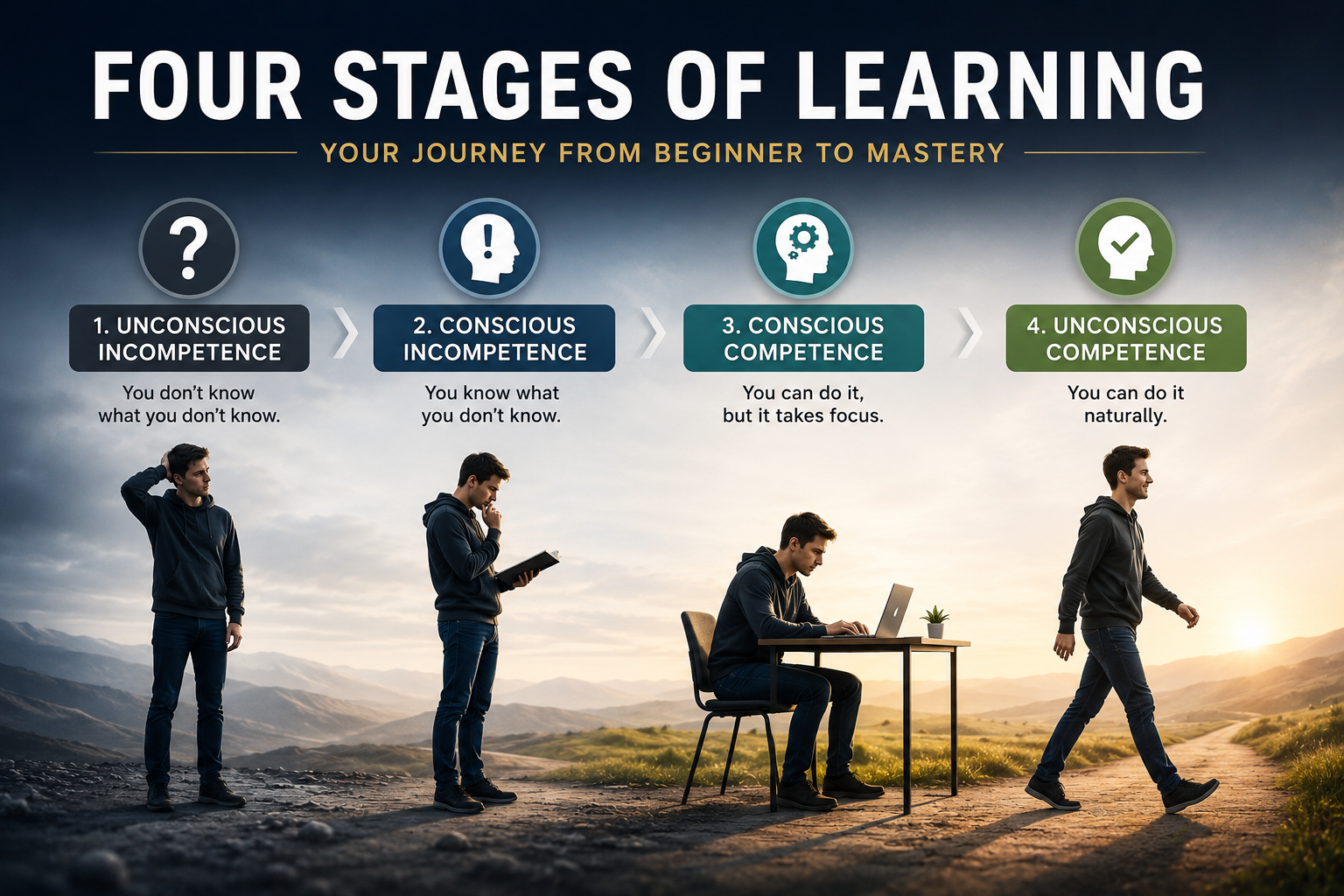
Four Stages of Learning Explained: From “I Don’t Know” to Unconscious Competence
Why does learning something new sometimes make you feel worse before you feel better?
At first, you may not even realise how much you do not know.
Then you begin learning and suddenly become aware of all your mistakes.
Later, you can perform the skill correctly — but only when you concentrate.
Eventually, after enough practice, the skill can begin to feel natural.
This progression is commonly described through the Four Stages of Learning, also known as the Four Stages of Competence or the conscious-competence model.
Kevin Trudeau discusses this framework as one of the foundational concepts associated with Your Wish Is Your Command.
The four stages are:
- Unconscious Incompetence — you do not know what you do not know
- Conscious Incompetence — you recognise what you cannot yet do
- Conscious Competence — you can do it, but it still requires concentration
- Unconscious Competence — the skill becomes increasingly automatic
The model is useful because it helps explain why becoming more aware of your weaknesses can actually be evidence that you are learning.
An important clarification is that Kevin Trudeau did not create the underlying four-stage competence model.
Versions of the framework existed before Your Wish Is Your Command and were developed and popularised within training and education decades earlier.
Trudeau incorporates the idea into his broader personal-development teaching and connects it with concepts such as the Teachability Index, the Training Balance Scale and Who Do You Listen To?.
This independent KevGuru guide explains each stage, shows how the model appears in real life and examines where it can be useful without treating it as a universal law of human learning.
Want to hear these ideas in the original training?
The current Free Your Wish offer includes the Your Wish Is Your Command Event Recording and Ebook at $0.
1. What Are the Four Stages of Learning?
The Four Stages of Learning describe a progression from having little awareness of a skill or knowledge gap to being able to perform a skill with very little conscious effort.
The four stages are:
- Unconscious Incompetence
- Conscious Incompetence
- Conscious Competence
- Unconscious Competence
The word “incompetence” can sound harsh.
Within this model, however, it simply means that a person has not yet developed sufficient knowledge or skill in a particular area.
Everyone is unconsciously incompetent at countless things.
You probably cannot repair every type of aircraft engine.
You may not know how to perform heart surgery.
You might not know how to speak Japanese.
That does not mean there is anything wrong with you.
It simply means those are skills or areas of knowledge you have not learned.
The model becomes useful when you decide that one of those skills matters to you.
At that point, awareness begins to change.
2. Stage One: Unconscious Incompetence
Stage One is Unconscious Incompetence.
The simplest explanation is:
You don’t know what you don’t know.
You may not realise a skill exists.
You may not understand its importance.
Or you may believe you are already more capable than you actually are.
Imagine someone who has never operated a business.
From the outside, business might appear straightforward:
Create a product.
Advertise it.
Sell it.
Make money.
But once they begin, they may discover subjects they had never seriously considered:
- customer acquisition costs
- cash flow
- pricing
- conversion rates
- tax
- customer retention
- legal requirements
- operations
- inventory
- staff management
Before entering the business, they were not necessarily choosing to ignore these subjects.
They simply did not know enough to recognise the gaps in their knowledge.
That is Stage One.
3. Why “You Don’t Know What You Don’t Know” Matters
The phrase can sound obvious, but it has an important implication.
If you do not know that a weakness exists, you are unlikely to improve it deliberately.
This can happen in almost every part of life.
Someone may believe they are a good listener until another person points out that they constantly interrupt.
A new manager may believe leadership simply means telling people what to do until they encounter problems involving motivation, communication and team dynamics.
A beginner investor may think investing is mainly about finding the next rapidly rising asset until they begin learning about risk, diversification and valuation.
The transition toward learning often begins when something makes the hidden gap visible.
That might be:
- a teacher
- a mentor
- a mistake
- failure
- feedback
- observation
- a new experience
- better information
This is one reason the Who Do You Listen To? concept matters.
A knowledgeable teacher can sometimes show you a problem you did not yet know existed.
4. Stage Two: Conscious Incompetence
Stage Two is Conscious Incompetence.
Now you know that you do not know.
This can feel worse than Stage One.
Previously, you may have felt confident because you were unaware of your limitations.
Now the limitations are obvious.
Imagine learning to play guitar.
At first, you might think:
“How difficult can it be?”
Then you try.
Your fingers hurt.
The chords sound wrong.
Changing between chords takes too long.
Your timing is inconsistent.
Suddenly you become extremely aware of everything you cannot yet do.
But this apparent decline in confidence can actually represent progress.
You have moved from:
“I don’t know that I can’t do this.”
to:
“I can clearly see what I need to learn.”
That awareness gives you something specific to work on.
5. Why Stage Two Can Feel So Uncomfortable
Conscious Incompetence may be the stage where many people are tempted to quit.
Mistakes become obvious.
Progress can feel slow.
Someone who looked talented from the outside suddenly makes the skill appear much harder than expected.
This is where people sometimes say:
“Maybe I’m just not good at this.”
But difficulty does not automatically mean inability.
It may simply mean you have become aware of the complexity involved.
Consider someone learning public speaking.
After their first serious training session, they may suddenly notice:
- how often they say “um”
- poor eye contact
- nervous movements
- weak openings
- speaking too quickly
- lack of pauses
They may feel less confident than before the training.
Yet they now possess something valuable:
awareness.
Once you can identify a specific weakness, you can practise it deliberately.
That makes Conscious Incompetence uncomfortable but potentially productive.
6. Stage Three: Conscious Competence
Stage Three is Conscious Competence.
At this point, you can perform the skill correctly, but doing so still requires deliberate attention.
Think about someone learning to drive.
They may now be capable of:
- checking mirrors
- indicating
- maintaining speed
- positioning the vehicle
- watching traffic
- changing lanes safely
But they have to think about each step.
Their internal conversation might sound like:
Check the mirror.
Signal.
Look over my shoulder.
Move gradually.
Cancel the indicator.
Check the speed.
The skill is working.
But it is not yet automatic.
This stage requires practice because the learner is converting knowledge into increasingly reliable behaviour.
Knowing how to do something and being able to perform it consistently are not always the same thing.
7. Stage Four: Unconscious Competence
Stage Four is Unconscious Competence.
After sufficient repetition and experience, parts of the skill become increasingly automatic.
Driving provides an obvious example.
An experienced driver may arrive somewhere and realise they barely remember consciously thinking about:
- changing gears
- checking mirrors
- steering through familiar roads
- maintaining lane position
Those behaviours have become highly practised.
The same thing can happen with:
- typing
- playing music
- sports
- speaking a language
- sales conversations
- workplace procedures
- customer service
The person is still performing the skill.
They simply require less conscious attention to perform familiar parts of it.
That creates mental capacity for higher-level decisions.
Learning the Four Stages Inside Your Wish Is Your Command
The Four Stages connect with the Teachability Index, Training Balance Scale and other foundational concepts discussed within the program.
8. A Real-World Example: Learning to Drive
Driving demonstrates the four stages clearly.
Stage One — Unconscious Incompetence
A young person has never driven.
They watch adults driving and may think it looks relatively simple.
They do not yet understand all the decisions occurring simultaneously.
Stage Two — Conscious Incompetence
They begin lessons.
Suddenly everything feels difficult.
Mirrors.
Pedals.
Traffic.
Road signs.
Steering.
Indicators.
Parking.
They now know how much they do not know.
Stage Three — Conscious Competence
After practice, they can drive safely but still concentrate heavily on each action.
Stage Four — Unconscious Competence
Years later, many basic driving behaviours happen automatically.
This example demonstrates an important point:
Competence usually develops through experience and repetition, not simply through understanding an explanation.
9. A Real-World Example: Learning to Sell
The model can also apply to business skills.
Imagine someone starting their first sales role.
At Stage One, they may think good salespeople simply talk confidently.
Then they begin selling.
They discover there is much more involved:
- asking good questions
- understanding customer needs
- listening
- explaining value
- handling objections
- building trust
- knowing when not to sell
- asking for a decision
They have entered Conscious Incompetence.
After training and practice, they learn a sales process.
But during each conversation they still consciously think:
Ask a question.
Listen.
Clarify the problem.
Explain the solution.
Check understanding.
That is Conscious Competence.
Eventually, an experienced salesperson may perform much of this naturally.
They listen and respond without consciously reciting a script.
That is closer to Unconscious Competence.
However, even experienced people can continue learning.
Automatic performance does not mean perfection.
10. Can You Move Backwards Through the Stages?
Yes.
The four stages should not necessarily be viewed as a perfectly straight staircase that you climb once and never revisit.
Someone can be highly competent in one environment and suddenly become consciously incompetent when circumstances change.
An experienced employee may master one software system.
Then the company introduces a completely new platform.
Suddenly the employee has to think carefully about tasks that previously felt automatic.
A confident driver from a country with left-hand traffic may need considerable concentration when first driving somewhere with right-hand traffic.
A successful business owner may enter a completely different industry and discover new gaps.
Learning can therefore involve:
- progress
- plateaus
- mistakes
- relearning
- adjustment
- new levels of complexity
The model is best used as a way of understanding learning — not as a rigid prediction of exactly how every person will progress.
11. Does Unconscious Competence Mean You Stop Learning?
No.
In fact, unconscious competence can create its own challenge.
When someone becomes extremely skilled, they may forget how difficult the skill once felt.
This can make teaching beginners surprisingly difficult.
An expert may say:
“You just do this.”
But the beginner cannot “just do it.”
The expert may have automated dozens of small decisions that the beginner still has to learn individually.
This creates an interesting paradox:
Being excellent at a skill does not automatically make someone excellent at teaching that skill.
Effective teachers often need to bring unconscious processes back into conscious awareness so they can explain them step by step.
They may need to ask:
What am I actually doing?
What decisions am I making automatically?
What does a beginner need to understand first?
That is another reason why choosing the right mentor involves more than simply finding someone successful.
12. How the Four Stages Connect With the Teachability Index
The Teachability Index and the Four Stages of Learning fit together naturally.
The Teachability Index asks:
How willing are you to learn?
and
How willing are you to change?
The Four Stages then describe what may happen as you develop a skill.
Suppose someone reaches Conscious Incompetence.
They can now see that their current approach is weak.
At that point, willingness to change becomes important.
They could say:
“I don’t like discovering that I’m bad at this, so I’m quitting.”
Or:
“Now that I know where the gap is, I can work on it.”
The same information produces different responses depending partly on how willing the person is to learn and change.
This is one reason these concepts appear together within Your Wish Is Your Command.
13. How They Connect With the Training Balance Scale
The Training Balance Scale adds another dimension.
Kevin Trudeau uses that framework to place considerable emphasis on internal preparation while still acknowledging external action.
The Four Stages demonstrate why actual practice remains important.
You cannot usually move from Conscious Incompetence to Unconscious Competence merely by thinking about a skill.
A guitarist needs to play.
A speaker needs to speak.
A salesperson needs conversations.
A driver needs driving experience.
Internal preparation may influence confidence, expectations and willingness to practise.
But developing competence generally requires interaction with the skill itself.
A balanced interpretation is therefore:
prepare internally, learn deliberately and practise in the real world.
14. Why Choosing the Right Teacher Still Matters
The Who Do You Listen To? principle also connects directly with learning.
When you enter Conscious Incompetence, you may be especially dependent on teachers because you know enough to recognise a problem but may not yet know how to solve it.
A useful teacher can help identify:
- what matters most
- what to practise first
- common mistakes
- unnecessary complexity
- what progress should look like
But KevGuru recommends evaluating teachers carefully.
Ask:
Do they have relevant expertise?
Can they explain the skill clearly?
Do they provide evidence where appropriate?
Can they distinguish opinion from fact?
Do they understand beginners?
Do their methods produce useful results?
The goal is not merely to find someone who knows more than you.
The goal is to find information that genuinely helps you progress.
15. Are the Four Stages of Learning Scientifically Proven?
The Four Stages of Competence are widely used as an educational and training framework.
The model has also been discussed in academic literature.
For example, a paper published in BMC Medical Education discusses the conscious-competency model using the progression from unconscious incompetence through to unconscious competence.
Read the academic discussion of the conscious-competency learning model
.
However, this does not mean every person learns every skill through four perfectly separated stages.
Learning is more complicated.
People can move backwards.
Skills can deteriorate.
Different parts of one skill may exist at different stages.
Stress can make automatic abilities less automatic.
New environments can expose new knowledge gaps.
KevGuru therefore recommends treating the Four Stages as a useful learning framework rather than an inflexible scientific law.
16. How to Use the Four Stages on Something You Are Learning
Choose one skill you are currently trying to improve.
It could be:
- public speaking
- selling
- writing
- leadership
- fitness
- learning software
- communication
- a new language
Then ask yourself:
Stage One — Is there anything I may not yet realise I need to learn?
Ask someone experienced for feedback.
Stage Two — What weaknesses am I now aware of?
Write them down specifically.
Stage Three — What can I currently do correctly when I concentrate?
Identify the behaviours that still require deliberate effort.
Stage Four — What has already become natural through repetition?
Recognise the progress you have made.
Then ask one final question:
What is the next specific skill I should practise?
That keeps the model practical.
Instead of judging yourself as “good” or “bad,” you identify where you are and what may help you move forward.
The KevGuru View
The Four Stages of Learning are one of the more useful concepts associated with Your Wish Is Your Command because they describe something most people have experienced.
At first you don’t know.
Then you realise how much you don’t know.
Then you can do it when you concentrate.
Eventually parts of the skill become natural.
The most important stage may actually be Conscious Incompetence.
That is often the moment when confidence drops.
But becoming aware of your weaknesses is not necessarily evidence that you are getting worse.
It may mean your understanding is becoming more accurate.
That changes the question from:
“Why am I so bad at this?”
to:
“What specifically do I need to practise next?”
KevGuru also believes it is important to distinguish Kevin Trudeau’s use of the model from the history of the model itself.
The underlying Four Stages of Competence framework existed before Your Wish Is Your Command.
Trudeau incorporates it into his broader system alongside the Teachability Index, Training Balance Scale and other concepts.
You can see how Kevin Trudeau currently places learning and related concepts within his broader framework here:
Kevin Trudeau’s current Your Wish Is Your Command framework
.
The practical lesson does not require you to accept every wider personal-development or manifestation claim.
It simply asks you to recognise that mastery usually develops over time.
Awareness creates something to improve.
Practice develops competence.
Repetition makes competent behaviour increasingly natural.
Explore the Original Your Wish Is Your Command Training
The current Free Your Wish offer includes the Event Recording and Ebook at $0, with the Event Recording currently presented as a 14-lesson training program.
GET YOUR WISH IS YOUR COMMAND FREE
You will leave KevGuru and be taken to the current external offer. Optional additional offers may appear and can be declined.
Want to Explore the Four Stages Inside Your Wish Is Your Command?
The Four Stages of Learning are discussed within the broader Your Wish Is Your Command training alongside concepts such as the Teachability Index, Training Balance Scale and choosing who you listen to.
At the time of writing, the current Free Your Wish offer includes the core Event Recording and Ebook at $0.
The Event Recording currently appears as a 14-lesson training program.
Optional additional offers may appear during signup, but they can be declined.
If you want to explore the original training for yourself, use KevGuru’s tracked link.
Always review the current offer details before registering because products, pricing, availability and access methods may change.
Affiliate disclosure: KevGuru may receive affiliate credit from qualifying future purchases through this link, at no additional cost to you.
Frequently Asked Questions About the Four Stages of Learning
What are the Four Stages of Learning?
The commonly used four-stage competence model consists of:
- Unconscious Incompetence
- Conscious Incompetence
- Conscious Competence
- Unconscious Competence
What does unconscious incompetence mean?
Unconscious incompetence means you lack a particular skill or knowledge but do not yet recognise the gap.
It is often described simply as:
You don’t know what you don’t know.
What is conscious incompetence?
Conscious incompetence occurs when you recognise that you do not yet possess the required knowledge or skill.
Although this stage can feel uncomfortable, awareness gives you something specific to learn and practise.
What is conscious competence?
Conscious competence means you can successfully perform the skill, but doing so still requires deliberate attention and concentration.
What is unconscious competence?
Unconscious competence describes a stage where extensive practice has made much of the skill feel natural or automatic.
The person can often perform it without consciously thinking through every individual step.
Did Kevin Trudeau create the Four Stages of Learning?
No.
Kevin Trudeau uses the Four Stages of Learning within his Your Wish Is Your Command teaching, but versions of the underlying conscious-competence model existed decades before the program.
Are the Four Stages of Learning scientifically proven?
The conscious-competence model is widely used in education, training and professional development and has also been discussed in academic literature.
However, it is better treated as a useful model for understanding skill development rather than a rigid scientific rule describing every learning process.
Can you move backwards through the Four Stages?
Yes.
People can return to more conscious stages when circumstances change, when they stop practising or when they encounter a more difficult version of a familiar skill.
How do the Four Stages connect with the Teachability Index?
The Teachability Index considers willingness to learn and willingness to change.
The Four Stages describe how awareness and competence may develop as someone learns and practises a skill.
How do the Four Stages connect with Your Wish Is Your Command?
Kevin Trudeau discusses the Four Stages as part of the broader Your Wish Is Your Command framework alongside concepts including the Teachability Index, Training Balance Scale and Who Do You Listen To?
Recommended Resources
- Your Wish Is Your Command – Independent Beginner’s Guide
- Teachability Index Explained
- Training Balance Scale – Kevin Trudeau’s 90/10 Rule Explained
- Who Do You Listen To? 7 Rules for Choosing Better Advice
- Your Wish Is Your Command Free Audio + Ebook: 7 Things to Know
- How to Access Your Wish Is Your Command: Teachable, Browser & 14 Lessons
- Get Your Wish Is Your Command Free
- KevGuru Personal Development Tools
- Free KevGuru Self-Assessment
- KevGuru Affiliate Disclosure
- Academic Discussion of the Conscious-Competency Model
- Kevin Trudeau’s Current Your Wish Is Your Command Framework