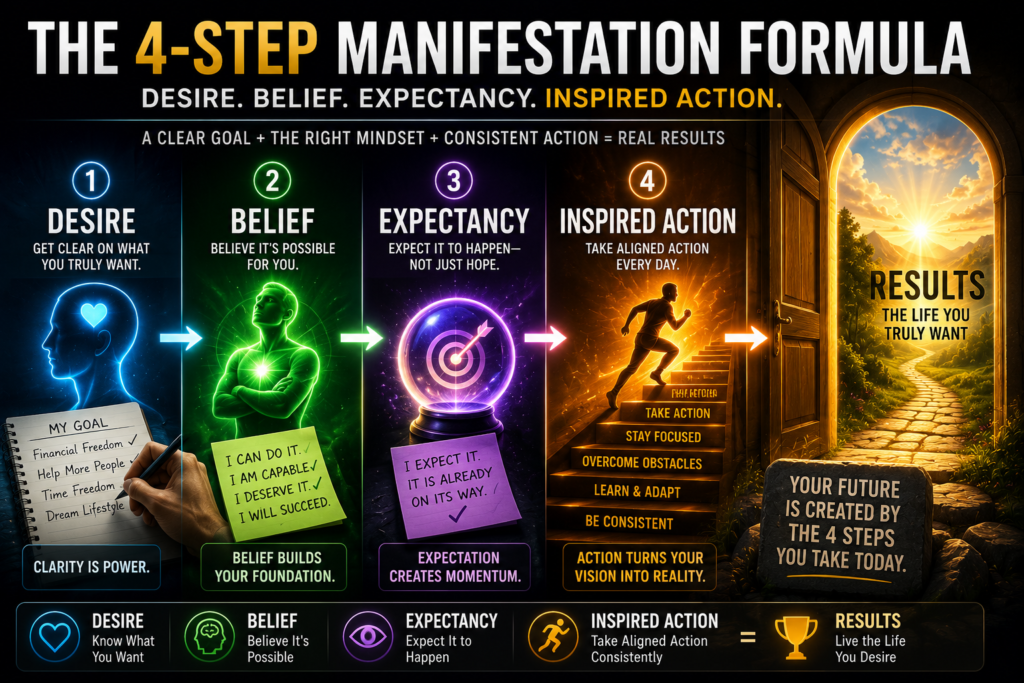
Kevin Trudeau 4-Step Manifestation Formula: Desire, Belief, Expectancy & Action Explained
Why can two people want similar things but approach their goals completely differently?
One person may have a vague wish:
“I would like to earn more money someday.”
Another person knows exactly what they want, believes the goal is achievable, expects progress to be possible and consistently takes action when opportunities appear.
Kevin Trudeau describes this process through what he calls his 4-Step Manifestation Formula.
The four parts are:
- Desire
- Belief
- Expectancy
- Inspired Action
Within Your Wish Is Your Command, Trudeau presents these four components as working together.
His argument is that wanting something is not enough.
You must become clear about what you want.
You must believe it is possible.
You must expect the result rather than merely hope for it.
And you must take action when opportunities appear.
This framework also connects directly with the Counter Intentions, Training Balance Scale, Teachability Index and Four Stages of Learning.
There is an important distinction, however.
Psychology provides research relevant to goals, confidence, expectations, planning and behaviour.
That does not establish that thoughts or emotional states directly cause the universe to deliver external outcomes.
This independent KevGuru guide explains the Kevin Trudeau 4-Step Manifestation Formula, examines each component separately and identifies where the framework overlaps with established ideas about goal pursuit — and where Trudeau moves beyond what scientific evidence currently supports.
Want to hear Kevin Trudeau explain the four steps in the original training?
The current Free Your Wish offer includes the Your Wish Is Your Command Event Recording and Ebook at $0.
1. What Is Kevin Trudeau’s 4-Step Manifestation Formula?
The Kevin Trudeau 4-Step Manifestation Formula is a framework Trudeau uses to explain how he believes people move from wanting a result to experiencing it.
The four components are:
- Desire — knowing clearly what you want
- Belief — believing the result is possible for you
- Expectancy — expecting rather than merely hoping
- Inspired Action — taking appropriate action when opportunities appear
Kevin Trudeau currently describes these four elements as a sequence.
If one part is weak, he argues that the overall process becomes less effective.
For example:
You may have strong desire but little belief.
You may believe something is possible but not genuinely expect it to happen.
You may have desire, belief and expectancy but fail to take action.
Or you may take enormous amounts of action toward something you never clearly defined.
The formula is Trudeau’s attempt to bring those elements together into one framework.
You can read his current description here:
Kevin Trudeau’s official 4-Step Manifestation Formula.
2. Step One: Desire
The first step is Desire.
Trudeau places considerable importance on clearly knowing what you want.
This sounds simple.
But many goals are surprisingly vague.
Someone may say:
“I want more money.”
How much?
Why?
By when?
Through what type of work or business?
Someone may say:
“I want a better relationship.”
What does “better” actually mean?
More communication?
Greater trust?
More time together?
Less conflict?
More emotional intimacy?
Someone may say:
“I want success.”
But success can mean completely different things to different people.
Without clarity, it becomes difficult to know what actions are actually relevant.
A useful interpretation of Desire is therefore:
Turn a vague wish into a goal you can understand clearly enough to act on.
3. Why Vague Wishes Are Different From Clear Goals
Consider these two statements.
Vague wish:
“I want to get healthier.”
Clearer goal:
“I want to build a routine where I walk for 30 minutes four times each week for the next three months.”
The second statement gives you something concrete to work with.
You can measure it.
You can plan it.
You can notice whether you are following through.
The same principle applies to money.
Vague:
“I want financial freedom.”
Clearer:
“I want to reduce my credit-card debt by $5,000 over the next 12 months.”
Goal-setting research has frequently examined how clarity, challenge, commitment, feedback and task complexity influence performance.
However, research also shows that goal setting is more nuanced than simply saying every goal must always be extremely specific.
Different situations can require different types of goals.
The practical point remains useful:
The clearer the outcome, the easier it usually becomes to identify the behaviour required to pursue it.
4. Step Two: Belief
The second step in the Kevin Trudeau 4-Step Manifestation Formula is Belief.
Trudeau does not mean merely saying:
“I believe.”
He argues that someone must genuinely believe the desired result is possible for them.
For example:
A person may consciously say:
“I want to build a successful business.”
But internally they may think:
“I am terrible at selling.”
“I don’t understand business.”
“People like me never succeed.”
“Customers will not pay that much.”
Those beliefs can influence behaviour.
Someone who expects rejection may hesitate to contact customers.
Someone who believes they are incapable may avoid difficult opportunities.
Someone who believes failure is inevitable may stop quickly when problems appear.
The practical idea is understandable:
What you believe about your ability can influence what you attempt, how long you persist and how you respond to difficulty.
That does not mean belief guarantees success.
It means beliefs can influence behaviour.
5. Belief vs Self-Efficacy
Psychology has a related concept called self-efficacy.
Self-efficacy generally refers to a person’s confidence in their ability to perform behaviours required in a particular situation.
That is more specific than simply saying:
“I believe I will become successful.”
For example:
“I believe I can learn how to give a sales presentation.”
“I believe I can follow this exercise plan.”
“I believe I can have this difficult conversation calmly.”
Research has linked self-efficacy with motivation, goal pursuit and persistence.
But self-efficacy should not be confused with Trudeau’s broader manifestation claim.
Believing you can perform a behaviour may influence whether you attempt and persist with that behaviour.
It does not establish that belief itself directly causes an external result to appear.
A useful question is therefore:
Do I believe I can perform the behaviours required to move toward this goal?
6. Step Three: Expectancy
The third step is Expectancy.
This is one of the areas where Trudeau makes an important distinction between:
hoping
and
expecting.
A person might say:
“I hope my business works.”
That contains uncertainty.
Trudeau contrasts this with expecting an outcome with greater confidence.
His current material uses examples such as ordering food at a restaurant.
Once you place the order, you normally do not sit at the table thinking:
“I wonder whether food exists.”
You expect the meal to arrive.
Trudeau applies this kind of certainty to goals.
KevGuru recommends interpreting this carefully.
Expectations can influence:
- motivation
- persistence
- attention
- willingness to attempt something
- how someone interprets setbacks
But expecting a result does not guarantee it.
External circumstances still matter.
7. What Is the Difference Between Belief and Expectancy?
These concepts can sound almost identical.
A useful distinction is:
Belief:
“I believe this result is possible.”
Expectancy:
“I genuinely expect this result to occur.”
Imagine someone considering a promotion.
They may believe:
“Yes, someone with my background can become a manager.”
That is belief in possibility.
But they may still think:
“I doubt I will be selected.”
That is low expectancy.
The distinction matters because people sometimes theoretically believe something is possible while emotionally expecting a different result.
Kevin Trudeau treats this difference as important within his formula.
From a practical perspective, it can be useful to ask:
What result do I actually expect when I take this action?
That answer may reveal assumptions you had not consciously examined.
The Formula Makes More Sense When You Understand the Whole System
Desire, Belief, Expectancy and Action connect directly with Counter Intentions and the Training Balance Scale.
8. Step Four: Inspired Action
The fourth step is Inspired Action.
Kevin Trudeau’s current material specifically uses the word “inspired.”
His distinction is between frantic activity and actions that appear relevant or aligned with the goal.
For example:
You decide to build a business.
You identify a potential customer.
You have an opportunity to speak with them.
You take the opportunity.
Or:
You want a new career.
Someone tells you about a position.
You research it.
You submit an application.
In practical terms, “inspired action” can be interpreted as:
recognising relevant opportunities and actually doing something with them.
KevGuru would be cautious about assuming that every intuition or coincidence represents guidance from the universe.
But there is nothing controversial about the idea that opportunities generally require action.
Seeing an opportunity is not the same as using it.
9. Why Action Still Matters
This point is particularly important because manifestation discussions can sometimes sound passive.
Think positively.
Visualise.
Believe.
Wait.
But Trudeau’s formula does include action.
Suppose someone wants a new job.
They can:
- clarify the role they want
- believe they can perform it
- expect that suitable opportunities exist
But if they never:
- improve their résumé
- search for jobs
- contact employers
- develop relevant skills
- attend interviews
the goal has little connection with observable behaviour.
This is where psychological research on implementation intentions becomes relevant.
An implementation intention converts a general goal into an if–then action.
For example:
“If it is 7:00 PM on Tuesday, I will spend 30 minutes reviewing suitable job openings.”
Research suggests this kind of planning can help translate intentions into action.
The practical principle is:
A goal becomes much more useful when it produces identifiable behaviour.
10. A Real-World Business Example
Imagine someone who wants to launch a consulting business.
We can apply the four steps.
Desire
Instead of:
“I want a successful business.”
They define:
“I want to build a consulting service helping small businesses improve their customer-service systems.”
Belief
They ask:
Do I believe I have or can develop the skills required?
If not, what skill is missing?
Expectancy
They examine what they genuinely expect.
Do they believe customers could realistically pay for this service?
Or do they expect every conversation to end in rejection?
Action
They:
- interview potential customers
- create an offer
- test pricing
- contact prospects
- collect feedback
- improve the service
Notice what this example does not require.
It does not require assuming that the universe will automatically produce customers.
The practical value of the formula is that it can organise:
clarity + confidence + expectation + behaviour.
11. A Money Example
Suppose someone wants to improve their finances.
Desire:
“I want to save $10,000.”
That is clearer than simply saying:
“I want more money.”
Belief:
“Do I believe I can create a realistic plan to save this amount?”
Expectancy:
“What do I genuinely expect will happen when I follow the plan?”
Action:
They may:
- review spending
- create automatic savings
- reduce unnecessary expenses
- increase income
- seek appropriate financial advice
This also connects with Counter Intentions.
Someone may consciously want financial progress while repeatedly performing behaviour that works against it.
That makes the four-step formula useful as a diagnostic structure:
Where is the breakdown?
Is the goal unclear?
Is belief low?
Is expectancy negative?
Or is action missing?
12. A Relationship Example
The same framework can be applied more cautiously to relationships.
Suppose someone wants a stronger relationship.
Desire:
They define what “stronger” means.
Better communication?
More trust?
More quality time?
Belief:
Do they believe improvement is possible?
Expectancy:
Do they expect conversations to improve — or automatically expect conflict?
Action:
They might:
- listen more carefully
- schedule time together
- communicate concerns respectfully
- change repeated behaviours
- seek professional support if needed
There is an important limitation.
A relationship involves another autonomous person.
You cannot “manifest” another person’s consent, feelings or choices through belief or expectancy.
The formula is most useful when applied to:
your own goals, expectations and behaviour.
13. How Counter Intentions Can Interfere With the Formula
This is where the previous article in our series becomes important.
Kevin Trudeau argues that Counter Intentions can interfere with the four steps.
For example:
Desire:
“I want financial success.”
Counter belief:
“Wealthy people are selfish.”
Or:
Desire:
“I want a close relationship.”
Counter belief:
“People eventually hurt you.”
From Trudeau’s perspective, the conscious desire and opposing internal belief create conflict.
A more conventional psychological interpretation might focus on:
- conflicting goals
- avoidance
- learned expectations
- habits
- fear
- self-regulation
Either way, the useful question is similar:
Is anything in my current thinking or behaviour consistently working against the goal I have defined?
14. How the Formula Connects With the Training Balance Scale
The Training Balance Scale connects directly with the formula.
Kevin Trudeau teaches an approximate 90/10 framework:
90% internal preparation
and
10% external action.
That places Desire, Belief and Expectancy primarily on the internal side.
Action appears on the external side.
KevGuru does not recommend interpreting the 90/10 ratio as scientifically established mathematics.
Different goals require different amounts of preparation and activity.
But the broader message can still be useful:
Do not concentrate only on action while ignoring the assumptions influencing the quality of that action.
At the same time:
Do not use internal preparation as an excuse to avoid action.
Both matter.
15. What Psychology Says About Desire, Belief, Expectancy and Action
There are psychological ideas that overlap with parts of Trudeau’s framework.
But they should not be treated as proof of manifestation.
Desire and goals
Goal-setting research examines how goal clarity, commitment, challenge, feedback and other factors influence behaviour and performance.
Belief
Self-efficacy research examines confidence in one’s ability to perform relevant behaviours.
Expectancy
Expectancy-based approaches to motivation recognise that expectations about whether a goal is attainable can influence motivation and persistence.
Action
Implementation-intention research examines how specific if–then plans can improve the translation of intentions into behaviour.
One particularly relevant area is mental contrasting with implementation intentions.
Mental contrasting involves thinking about a desired future while also identifying real obstacles.
Implementation intentions then create plans for responding to those obstacles.
A meta-analysis of 21 studies involving 15,907 participants found a small-to-moderate positive effect on goal attainment, while also noting limitations and possible publication bias.
You can read the research here:
Meta-analysis of mental contrasting and implementation intentions.
This evidence supports practical ideas about goals, expectations, obstacles and action.
It does not establish that thoughts directly command external reality.

16. Is the 4-Step Manifestation Formula Scientifically Proven?
No evidence establishes the complete Kevin Trudeau 4-Step Manifestation Formula as a scientifically validated law of manifestation.
That distinction matters.
Scientific research does support or investigate related ideas such as:
- goal setting
- self-efficacy
- expectations
- motivation
- planning
- habit formation
- implementation intentions
- self-regulation
But those findings do not establish claims that:
- thoughts directly attract external events
- expectancy guarantees an outcome
- vibrational alignment controls circumstances
- belief alone produces money or relationships
Real-world outcomes depend on many factors.
These may include:
- skills
- resources
- timing
- other people
- economic conditions
- health
- competition
- opportunity
- luck
- circumstances outside your control
KevGuru therefore recommends separating:
the formula as a personal-development framework
from
claims that it operates as a universal law governing external reality.
17. Try the Four Steps on One of Your Own Goals
You can use the formula as a practical reflection exercise without assuming every manifestation claim is true.
Choose one goal.
Then work through the four steps.
STEP 1 — DESIRE
What exactly do I want?
Write it clearly.
Avoid vague language.
STEP 2 — BELIEF
Do I believe I can perform the behaviours necessary to pursue this goal?
If not, what ability or resource am I missing?
STEP 3 — EXPECTANCY
What result do I honestly expect?
Why?
What evidence is influencing that expectation?
STEP 4 — ACTION
What is the next observable action?
Make it specific.
For example:
“If it is 9:00 AM tomorrow, I will contact three potential customers.”
Then add one more question:
What obstacle is most likely to stop me?
Create a response for that obstacle.
This turns a broad personal-development formula into something measurable and practical.
The KevGuru View
The Kevin Trudeau 4-Step Manifestation Formula becomes most useful when you separate its practical components from its larger metaphysical claims.
The practical components are easy to understand.
Know what you want.
Examine whether you believe you can pursue it.
Notice what you genuinely expect.
Take appropriate action.
Those questions can expose problems.
Maybe your goal is vague.
Maybe you lack confidence in a particular skill.
Maybe you expect failure because of previous experience.
Maybe you know exactly what to do but continually avoid doing it.
That kind of examination can be valuable.
Where KevGuru becomes more cautious is the claim that desire, belief and expectancy themselves cause external reality to rearrange.
There is an important difference between saying:
“My beliefs influence how I behave.”
and:
“My beliefs directly cause external events.”
The first has considerable overlap with psychology.
The second requires much stronger evidence.
Our recommendation is therefore:
Use the formula to create clarity.
Use it to examine expectations.
Use it to identify behavioural obstacles.
Use it to decide what action comes next.
But continue evaluating real-world evidence and results.
A useful personal-development framework should improve your decisions — not replace reality testing.
Explore the 4-Step Formula in the Original Training
The current Free Your Wish offer includes the Your Wish Is Your Command Event Recording and Ebook at $0, with the Event Recording currently presented as a 14-lesson training program.
GET YOUR WISH IS YOUR COMMAND FREE
You will leave KevGuru and be taken to the current external offer. Optional additional offers may appear and can be declined.
Explore the Formula Inside Your Wish Is Your Command
Desire, Belief, Expectancy and Inspired Action form one of the central frameworks discussed within Kevin Trudeau’s Your Wish Is Your Command material.
The formula also connects with:
- Counter Intentions
- the Teachability Index
- the Training Balance Scale
- the Four Stages of Learning
- goal clarity
- expectations
- action
At the time of writing, the current Free Your Wish offer includes the core Event Recording and Ebook at $0.
The Event Recording currently appears as a 14-lesson training program.
Optional additional offers may appear during signup, but they can be declined.
If you want to examine Kevin Trudeau’s original teaching for yourself, use KevGuru’s tracked link.
Always review the current external offer before registering because products, pricing, availability and access methods may change.
Affiliate disclosure: KevGuru may receive affiliate credit from qualifying future purchases through this link, at no additional cost to you.
Frequently Asked Questions About Kevin Trudeau’s 4-Step Manifestation Formula
What is Kevin Trudeau’s 4-Step Manifestation Formula?
Kevin Trudeau describes a four-part formula consisting of Desire, Belief, Expectancy and Inspired Action.
He teaches these as interconnected components within Your Wish Is Your Command.
What are the four manifestation steps?
The four steps are:
- Desire
- Belief
- Expectancy
- Inspired Action
What does Desire mean in the formula?
Desire refers to becoming clear about what you actually want rather than relying on a vague wish.
What does Belief mean?
Kevin Trudeau uses Belief to describe genuine conviction that the desired outcome is possible.
A practical interpretation is to examine whether you believe you can perform the behaviours required to pursue your goal.
What does Expectancy mean?
Expectancy refers to what you genuinely expect to happen.
Trudeau distinguishes expecting something from merely hoping that it might happen.
What is Inspired Action?
Kevin Trudeau describes Inspired Action as taking relevant action when opportunities or appropriate next steps appear.
KevGuru recommends interpreting this practically rather than assuming every intuition or coincidence is external guidance.
Is the Kevin Trudeau 4-Step Manifestation Formula scientifically proven?
No.
The complete formula is not a scientifically validated manifestation law.
Research does examine related concepts including goals, self-efficacy, expectancy, motivation, planning and implementation intentions.
Does belief guarantee success?
No.
Beliefs can influence motivation and behaviour, but outcomes also depend on skills, resources, circumstances, other people, opportunity and many other factors.
What is the difference between Belief and Expectancy?
Belief can be understood as believing that an outcome is possible.
Expectancy refers more directly to whether you actually expect that outcome to occur.
How do Counter Intentions connect with the formula?
Kevin Trudeau argues that Counter Intentions can create internal conflict with Desire, Belief or Expectancy.
A practical interpretation is to examine whether repeated beliefs or behaviours consistently work against your stated goal.
How does the Training Balance Scale connect with the formula?
Trudeau places Desire, Belief and Expectancy primarily on the internal side of his Training Balance Scale, while Inspired Action represents the external component.
Do I need to believe in manifestation to use the four steps?
No.
The framework can also be used as a practical goal-reflection exercise involving clarity, confidence, expectations and action without accepting broader metaphysical claims.
Recommended Resources
- Your Wish Is Your Command – Independent Beginner’s Guide
- Kevin Trudeau Counter Intentions Explained
- Teachability Index Explained
- Training Balance Scale – Kevin Trudeau’s 90/10 Rule Explained
- Who Do You Listen To? 7 Rules for Choosing Better Advice
- Four Stages of Learning Explained
- Money Processes Review
- Relationship Processes Review
- Your Wish Is Your Command Free Audio + Ebook: 7 Things to Know
- How to Access Your Wish Is Your Command: Teachable, Browser & 14 Lessons
- Get Your Wish Is Your Command Free
- Free KevGuru Self-Assessment
- KevGuru Affiliate Disclosure
- Kevin Trudeau’s Official 4-Step Manifestation Formula
- Research on Mental Contrasting, Expectations and Implementation Intentions