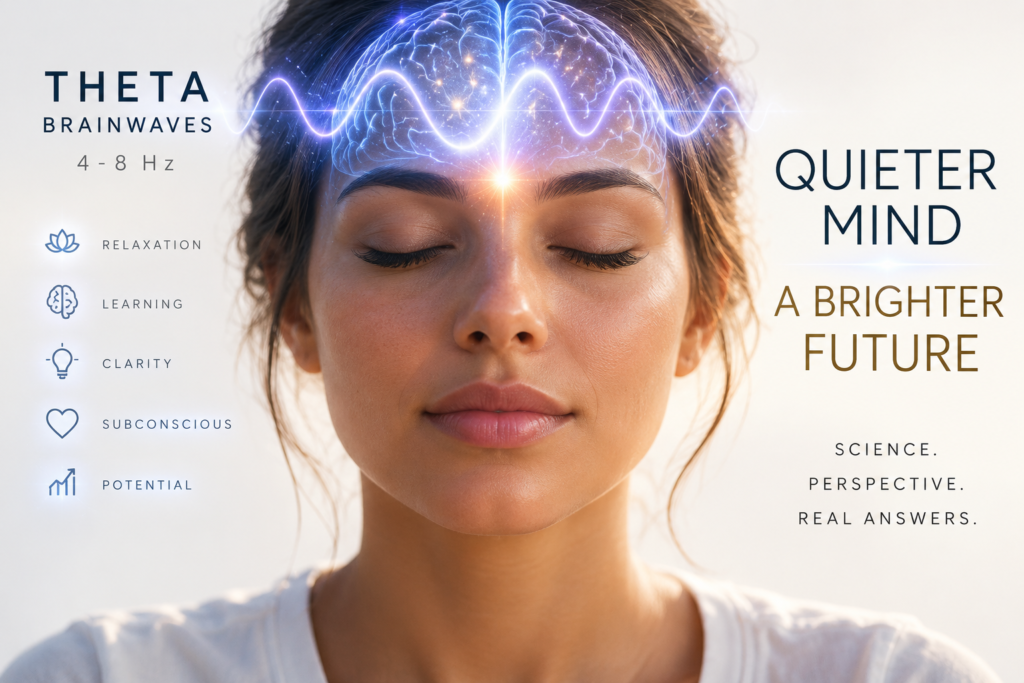
Kevin Trudeau Theta State Explained: What Science Really Says About Theta Brainwaves
Theta brainwaves sound almost mysterious when they are discussed in personal-development programs.
They are associated with meditation.
They appear around sleep.
They have been studied in memory and learning.
They have also been linked with hypnosis, internal attention and certain forms of cognitive processing.
Within Your Wish Is Your Command, however, Kevin Trudeau takes the idea considerably further.
He teaches that deliberately entering what he calls the THETA state can make the subconscious mind more receptive, help people work with Counter Intentions and strengthen the manifestation process.
According to Trudeau’s current explanation, theta is a particularly important state for working with beliefs and desires.
But what exactly are theta brainwaves?
Does the brain really enter one special frequency?
Is theta scientifically associated with learning, memory and meditation?
Does being in theta make the subconscious mind easier to “reprogram”?
And is there evidence that theta brainwaves make manifestation more powerful?
This independent KevGuru guide examines the Kevin Trudeau Theta State alongside current neuroscience so that we can separate three things clearly:
what Kevin Trudeau teaches
what scientific research actually supports
and
what remains unproven.
This article also connects directly with our guides to the Kevin Trudeau 4-Step Manifestation Formula, Counter Intentions, Training Balance Scale and Your Wish Is Your Command.
Want to hear Kevin Trudeau explain the Theta State in the original training?
The current Free Your Wish offer includes the Your Wish Is Your Command Event Recording and Ebook at $0.
1. What Is the Kevin Trudeau Theta State?
The Kevin Trudeau Theta State refers to Trudeau’s teaching that a theta-dominant brainwave condition can provide unusually direct access to the subconscious mind.
In his current Your Wish Is Your Command material, Trudeau generally places brain activity into familiar frequency categories such as:
- Beta — ordinary waking and analytical activity
- Alpha — relaxed awareness
- Theta — deeper relaxation, meditation and the transition toward sleep
- Delta — deep sleep
Trudeau gives theta special importance.
He teaches that ordinary conscious thinking can contain doubt, analysis, limiting beliefs and what he calls Counter Intentions.
According to his framework, entering theta reduces this conscious interference and makes deeper mental programming easier to influence.
Trudeau then connects this state with:
- visualisation
- desire
- belief
- expectancy
- Counter Intentions
- subconscious programming
- manifestation
You can read Kevin Trudeau’s own current explanation here:
Kevin Trudeau’s Theta State Manifestation explanation.
The important question for an independent review is not whether theta brain activity exists.
It unquestionably does.
The more difficult question is what theta activity actually means and whether the additional manifestation claims are supported by evidence.
2. What Are Theta Brainwaves?
Theta brainwaves are not mystical energy.
They are patterns of electrical activity measured in the brain.
When large groups of neurons interact rhythmically, their electrical activity can be analysed using techniques such as electroencephalography, or EEG.
Researchers commonly group some of this activity into frequency ranges.
Theta generally refers to activity around:
4–8 Hz in many human EEG studies.
That means approximately four to eight oscillatory cycles per second.
Other commonly discussed ranges include alpha, beta, delta and gamma.
However, the exact boundaries are not universal.
Different researchers and different areas of neuroscience sometimes use slightly different frequency definitions.
This matters because phrases such as:
“Your brain is in theta”
can make the phenomenon sound much simpler than it actually is.
Theta is a real category of neural oscillatory activity.
But understanding what it means requires knowing:
- where in the brain it appears
- when it appears
- what task someone is performing
- whether they are awake, sleepy or asleep
- how the activity is being measured
3. Does Your Brain Operate at Only One Frequency?
This is one of the most important distinctions in the entire article.
Popular explanations sometimes suggest that your whole brain switches between frequencies like changing radio stations:
Beta.
Then Alpha.
Then Theta.
Then Delta.
The real brain is more complicated.
Different neural networks can show different oscillatory patterns at the same time.
Theta activity can increase in one region while other frequency activity continues elsewhere.
Different frequencies can also interact.
Therefore, saying:
“I am in theta”
is convenient personal-development language.
Scientifically, it is usually more accurate to say that:
theta-band activity has increased or become prominent in particular brain regions under particular conditions.
That distinction does not make theta less interesting.
It simply prevents a real neuroscience phenomenon from being turned into something more simplistic than the evidence supports.
4. When Does Theta Activity Naturally Occur?
Theta-band activity has been observed in several very different situations.
These include:
- drowsiness
- sleep-related transitions
- memory processes
- working memory
- attention
- cognitive control
- error monitoring
- some meditation practices
- some hypnotic conditions
This produces an interesting problem.
Theta cannot simply mean:
“deep relaxation.”
Research has found theta activity not only when people become sleepy but also during demanding cognitive tasks requiring active mental control.
A neuroscience study described this as the “theta paradox” because 4–8 Hz activity has been associated both with drowsiness and with alert cognitive control.
You can examine that research here:
The Theta Paradox: 4–8 Hz EEG Oscillations Reflect Both Sleep Pressure and Cognitive Control.
This tells us something important.
The existence of theta activity does not by itself tell us exactly what psychological state someone is experiencing.
5. Theta Brainwaves and Drowsiness
Kevin Trudeau often describes theta as occurring around the boundary between waking and sleeping.
There is legitimate neuroscience behind part of this description.
Theta activity can increase as people become drowsy and as sleep pressure rises.
Think about those moments when you are lying in bed and are:
not completely awake
but
not completely asleep.
Thoughts may become less structured.
Images can appear spontaneously.
Attention to the outside world decreases.
This transition is often called the hypnagogic period.
Theta activity can be associated with these transitions.
But this does not mean every appearance of theta represents a hypnagogic state.
As we have already seen, theta is also involved in active cognition.
So the statement:
“Theta can occur around drowsiness and sleep transitions”
is reasonable.
The statement:
“Theta always means you are in a special subconscious state”
would go beyond the evidence.
6. Theta Brainwaves and Meditation
This is another area where personal-development teachings overlap with genuine research.
Scientists have studied EEG activity during several forms of meditation.
A systematic review examining focused-attention, open-monitoring, transcendental and loving-kindness meditation found changes in neural oscillatory activity across different meditation styles.
Some forms of meditation have been associated with increased theta activity, particularly in frontal regions.
You can read the review here:
Review of Neural Oscillations Underlying Meditation.
That makes it reasonable to say:
some meditation practices can be associated with increased theta activity.
But several cautions are necessary.
Meditation is not one single mental condition.
Different meditation styles produce different patterns.
Experience levels matter.
Brain regions matter.
Alpha, gamma and other frequency bands can also change.
Therefore:
meditation does not simply equal theta.
And finding theta during meditation does not prove that meditation allows someone to manifest external events.
7. Theta Brainwaves, Learning and Memory
Theta activity has an important relationship with memory research.
The hippocampus — a brain structure heavily involved in learning and memory — has been extensively studied in relation to theta rhythms.
Human studies have found relationships between theta activity and processes involved in:
- memory encoding
- memory retrieval
- working memory
- associative memory
- communication between brain regions
But even here, the story is not as simple as:
“More theta equals better memory.”
A major review of theta oscillations in human memory found a complicated literature.
Some studies found increases in theta power during successful memory processes.
Other studies found decreases.
Results varied depending on:
- the recording technique
- the brain region
- the memory task
- the timing of measurement
You can review this evidence here:
Theta Oscillations in Human Memory.
The appropriate conclusion is therefore:
Theta rhythms clearly participate in important memory processes, but they are not a simple “super learning frequency.”
8. Theta and Cognitive Control
Theta becomes even more interesting when we look at the front of the brain.
Researchers have studied something called frontal midline theta.
This activity has been associated with situations requiring:
- attention
- decision-making
- error detection
- conflict monitoring
- working memory
- behavioural adjustment
- cognitive control
For example, imagine performing a difficult task and suddenly recognising:
“I made a mistake. I need to change what I am doing.”
Theta activity over frontal areas can be involved in this kind of control process.
That creates an interesting contrast with the popular idea that theta simply represents a non-analytical subconscious condition.
In some circumstances, theta is associated with very active cognitive processing.
This again demonstrates why we should avoid turning one frequency band into one universal mental state.
Theta Is Only One Part of the Your Wish Is Your Command System
See how Theta connects with Counter Intentions, Desire, Belief, Expectancy and Inspired Action.
9. Theta Brainwaves and Hypnosis
This is perhaps the most interesting area when considering Trudeau’s idea of increased subconscious receptivity.
Research has examined EEG patterns during hypnosis and hypnotic suggestibility.
Several studies and reviews have found associations between theta activity and hypnosis.
For example, people who are highly hypnotizable have sometimes shown different theta patterns from people with lower hypnotizability.
Some hypnotic procedures have also been associated with changes in theta activity.
However, the research is not completely consistent.
A modern review covering decades of hypnosis neuroscience reported that theta is one of the more frequently observed EEG relationships with hypnosis, but it also noted studies that failed to find theta changes and findings that varied between people and experimental conditions.
You can read the review here:
Brain Functional Correlates of Hypnosis and Hypnotizability.
So there is a scientifically interesting relationship between:
theta activity + hypnosis + suggestibility.
But that does not establish the much stronger claim that entering theta automatically opens a subconscious programming portal.
10. Does Theta Make the Subconscious More Receptive?
This requires careful wording.
Kevin Trudeau teaches that theta makes the subconscious mind more accessible and receptive to new programming.
There are research areas that make this idea sound plausible at first glance.
Theta activity has relationships with:
- memory
- internal attention
- meditation
- hypnosis
- learning processes
Hypnosis itself can involve greater responsiveness to suggestion in some people.
However:
there is not sufficient scientific evidence to conclude that reaching 4–8 Hz theta activity creates a universal window in which the subconscious mind can simply be rewritten.
The term subconscious is also used much more broadly in personal-development literature than in modern cognitive neuroscience.
Brains do contain enormous amounts of automatic and non-conscious processing.
Habits, learned associations, emotional responses and memories can influence behaviour without deliberate conscious thought.
But science does not describe all of this as one single subconscious storage area waiting to be opened at a particular frequency.
A more cautious interpretation would be:
Relaxed or focused mental states may provide useful conditions for reflection, imagery, attention and suggestion, but that is not the same as proving direct subconscious reprogramming.
11. Can Theta Reprogram Limiting Beliefs?
Suppose someone believes:
“I always fail when I try something new.”
Could meditation or a relaxed state help them reflect on that belief?
Possibly.
Could mental imagery help them rehearse a different behaviour?
Possibly.
Could hypnosis or psychological techniques alter certain learned responses?
In some contexts, yes.
But saying:
“I entered theta and deleted the belief”
would be a much stronger claim.
Beliefs can be influenced through many mechanisms, including:
- new experiences
- education
- repetition
- evidence
- behavioural change
- social influence
- therapy
- reflection
- practice
A relaxed mental exercise may be one part of someone’s personal-development routine.
It should not automatically be treated as a scientifically established method of erasing unwanted mental programming.
12. Theta State and Counter Intentions
This is where the Kevin Trudeau Counter Intentions concept enters the system.
Trudeau teaches that a person may consciously desire something while holding another internal belief that works against it.
For example:
Conscious intention:
“I want financial success.”
Possible Counter Intention:
“Having lots of money makes people selfish.”
His framework suggests that theta provides an opportunity to work with those deeper patterns.
KevGuru recommends separating two different ideas.
Idea One:
It can be useful to identify contradictory beliefs and behaviours.
That is reasonable.
Idea Two:
Entering theta allows someone to directly remove those beliefs from the subconscious.
That specific mechanism requires stronger evidence.
You can still use the exercise without assuming the explanation has been scientifically proven.
For example, during a quiet reflective period, ask:
What do I consciously want?
What do I genuinely expect?
What am I afraid will happen if I succeed?
What behaviour repeatedly works against my goal?
Those questions can reveal useful information whether or not theta has any special manifestation power.
13. Does Theta Make Manifestation More Powerful?
This is where the scientific evidence and Kevin Trudeau’s manifestation teaching separate most clearly.
Trudeau’s current material gives theta a powerful role in manifestation.
He argues that intentions introduced during theta have greater influence than intentions generated during ordinary beta activity.
Science does not currently establish this.
There is evidence that theta oscillations participate in:
- memory
- learning
- attention
- cognitive control
- drowsiness
- meditation
- some aspects of hypnosis
But that does not demonstrate that theta:
- attracts money
- causes opportunities to appear
- changes another person’s behaviour
- controls external events
- amplifies a manifestation command
- communicates desires to the universe
Those are separate claims.
This distinction is essential.
Evidence that a brain state exists is not evidence that every claimed power attributed to that brain state is real.
14. Can You Deliberately Enter a Theta State?
People can intentionally practise activities associated with changes in brain rhythms.
Meditation is an obvious example.
Relaxation practices may also alter EEG activity.
Hypnosis and some forms of neurofeedback have been studied in relation to brainwave patterns.
However, there is an important practical limitation.
Without measuring brain activity using EEG, you normally cannot know with precision:
“I am now producing exactly this amount of theta activity.”
Feeling deeply relaxed does not prove a particular EEG measurement.
Feeling sleepy does not mean your entire brain has entered one frequency.
Meditating successfully does not require watching a brainwave monitor.
For most readers, a better practical goal is:
create a calm, focused environment in which you can reflect clearly.
Whether the precise EEG pattern meets a particular definition of theta may be less important than what you actually do with the time.
15. What Science Supports vs What Remains Unproven
Here is the clearest way to separate the evidence.
| Claim | Evidence Status |
|---|---|
| Theta brain activity exists | Well established |
| Human theta is commonly studied around 4–8 Hz | Well established, although frequency definitions can vary |
| Theta can occur during drowsiness | Supported |
| Some meditation practices are associated with theta changes | Supported |
| Theta participates in memory processes | Supported, but complex |
| Theta participates in cognitive control | Supported |
| Theta has associations with hypnosis and hypnotizability | Some supporting evidence, with mixed findings |
| Theta automatically opens the subconscious for reprogramming | Not established |
| Theta automatically removes Counter Intentions | Not established |
| Theta makes manifestation commands affect external reality | Not scientifically established |
That is the distinction KevGuru believes readers should understand.
16. A Practical Way to Use the Theta Idea
You do not need an EEG machine or a belief in manifestation to experiment with the practical part of the concept.
Try creating a calm reflection period.
Choose somewhere quiet.
Reduce distractions.
Allow yourself several minutes to relax.
Then choose one goal.
Ask:
What exactly do I want?
Then:
What do I genuinely believe about achieving it?
Then:
What result do I honestly expect?
Then:
What fear or conflicting belief appears when I imagine succeeding?
Finally:
What action can I take next?
For example:
Goal:
“I want to grow my business.”
Possible belief:
“I am uncomfortable approaching potential customers.”
Possible expectation:
“I expect people to reject me.”
Possible Counter Intention:
“If my business grows, I will become overwhelmed.”
Next action:
“I will contact three potential customers tomorrow and observe what actually happens.”
Notice what this exercise does.
It combines:
reflection + awareness + reality testing + action.
That is considerably more useful than simply waiting for a particular brain frequency to produce the result.
17. How Theta Connects With the 4-Step Manifestation Formula
The previous article in our roadmap explained the Kevin Trudeau 4-Step Manifestation Formula:
Desire
Belief
Expectancy
Inspired Action
Trudeau’s broader framework places theta underneath these steps as a way of strengthening internal alignment.
In simplified form:
Desire
What do I want?
Belief
Do I believe it is possible?
Expectancy
Do I expect it?
Theta
Can I work with the deeper beliefs influencing these answers?
Action
What do I do next?
From Trudeau’s perspective, theta increases the effectiveness of the entire process.
From an evidence-based perspective, we can make a more cautious interpretation.
A quiet, focused mental state may help someone:
- reflect
- visualise
- notice beliefs
- reduce immediate distractions
- rehearse behaviour
- clarify a goal
Then the important test becomes:
Does that reflection lead to better behaviour and better decisions in the real world?
The KevGuru View
The Kevin Trudeau Theta State is a perfect example of why KevGuru takes an independent approach to Your Wish Is Your Command.
There is a fascinating piece of real neuroscience underneath the teaching.
Theta brain activity is real.
Theta is connected with important aspects of:
- memory
- learning
- cognitive control
- drowsiness
- meditation
- hypnosis
That makes the subject worthy of attention.
But then we need to stop and ask:
Where does the evidence end?
Science does not currently demonstrate that 4–8 Hz theta activity automatically opens a subconscious programming channel.
It does not demonstrate that theta removes Counter Intentions.
And it does not establish that a thought generated in theta has greater power to alter external reality.
Those are Kevin Trudeau’s personal-development and manifestation claims.
They should be identified as such.
At the same time, dismissing theta entirely because some claims go beyond the evidence would also be a mistake.
The neuroscience itself is extremely interesting.
A reasonable practical interpretation is:
Use relaxation or meditation to create space for focused reflection.
Examine your beliefs.
Identify contradictions.
Clarify what you want.
Decide what action follows.
Then test your assumptions against reality.
That approach allows you to explore the useful parts of the teaching without needing to treat every explanation as scientifically proven.
Explore Kevin Trudeau’s Theta Teaching for Yourself
The current Free Your Wish offer includes the Your Wish Is Your Command Event Recording and Ebook at $0, with the Event Recording currently presented as a 14-lesson training program.
GET YOUR WISH IS YOUR COMMAND FREE
You will leave KevGuru and be taken to the current external offer. Optional additional offers may appear and can be declined.
Explore Theta Inside Your Wish Is Your Command
The Theta State is one part of the broader Your Wish Is Your Command framework.
It connects with:
- Counter Intentions
- Desire, Belief, Expectancy and Inspired Action
- the Training Balance Scale
- the Teachability Index
- the Four Stages of Learning
At the time of writing, the current Free Your Wish offer includes the core Event Recording and Ebook at $0.
The Event Recording currently appears as a 14-lesson training program.
Optional additional offers may appear during signup, but they can be declined.
If you want to hear Trudeau’s complete explanation rather than relying on summaries, you can examine the current training for yourself.
Always review the external offer before registering because products, pricing, availability and access methods can change.
Affiliate disclosure: KevGuru may receive affiliate credit from qualifying future purchases through this link, at no additional cost to you.
Frequently Asked Questions About the Kevin Trudeau Theta State
What is the Kevin Trudeau Theta State?
The Kevin Trudeau Theta State refers to Trudeau’s teaching that theta brainwave activity provides a particularly receptive condition for working with beliefs, Counter Intentions, desires and manifestation.
What frequency are theta brainwaves?
Human theta EEG activity is commonly discussed at approximately 4–8 Hz, although exact frequency boundaries can vary between studies and research contexts.
Are theta brainwaves real?
Yes.
Theta oscillations are genuine patterns of neural electrical activity studied extensively using EEG and other neuroscience techniques.
When do theta brainwaves occur?
Theta activity has been observed during drowsiness, sleep-related transitions, memory tasks, cognitive control, some meditation practices and some hypnotic conditions.
Are theta brainwaves only produced during deep relaxation?
No.
Theta can occur during relaxation and drowsiness, but frontal theta activity is also associated with demanding cognitive processes such as attention, error monitoring and cognitive control.
Does meditation increase theta brainwaves?
Some forms of meditation have been associated with increased theta activity.
However, meditation produces complex neural changes involving multiple frequency bands, and results vary according to meditation style, experience and brain region.
Are theta waves linked with memory?
Yes.
Theta oscillations have important relationships with memory encoding, retrieval and communication between memory-related brain regions.
However, the relationship is complex and more theta does not automatically mean better memory.
Is theta associated with hypnosis?
Research has found relationships between theta activity, hypnotic responding and hypnotizability.
However, studies are not completely consistent and theta is not considered a simple universal marker of hypnosis.
Does theta open the subconscious mind?
Science does not currently establish that reaching theta activity creates a universal gateway through which the subconscious can simply be reprogrammed.
That is a stronger claim associated with some personal-development and hypnosis explanations.
Can theta remove Counter Intentions?
Kevin Trudeau teaches a connection between theta and Counter Intentions.
Scientific evidence does not currently establish that theta activity automatically removes subconscious beliefs or internal conflicts.
Does theta make manifestation work?
There is no established scientific evidence that theta brainwaves cause thoughts or intentions to produce desired external events.
Theta’s documented neurological functions should not be confused with proof of manifestation.
Can I deliberately produce theta brainwaves?
Meditation, relaxation, hypnosis and neurofeedback can be associated with changes in brainwave activity.
However, without EEG measurement you generally cannot know precisely how much theta activity is occurring.
Do I need to believe in manifestation to find theta interesting?
No.
Theta oscillations are an important area of neuroscience regardless of whether someone accepts Law of Attraction or manifestation claims.
Recommended Resources
- Your Wish Is Your Command – Independent Beginner’s Guide
- Kevin Trudeau 4-Step Manifestation Formula Explained
- Kevin Trudeau Counter Intentions Explained
- Training Balance Scale – Kevin Trudeau’s 90/10 Rule Explained
- Teachability Index Explained
- Four Stages of Learning Explained
- Who Do You Listen To? 7 Rules for Choosing Better Advice
- Your Wish Is Your Command Free Audio + Ebook: 7 Things to Know
- How to Access Your Wish Is Your Command: Teachable, Browser & 14 Lessons
- Get Your Wish Is Your Command Free
- Free KevGuru Self-Assessment
- KevGuru Affiliate Disclosure
- Kevin Trudeau’s Official Theta State Explanation
- Scientific Research: The Theta Paradox
- Scientific Review of Brain Oscillations During Meditation
- Scientific Review of Theta Oscillations in Human Memory
- Scientific Review of Hypnosis, Hypnotizability and Brain Activity