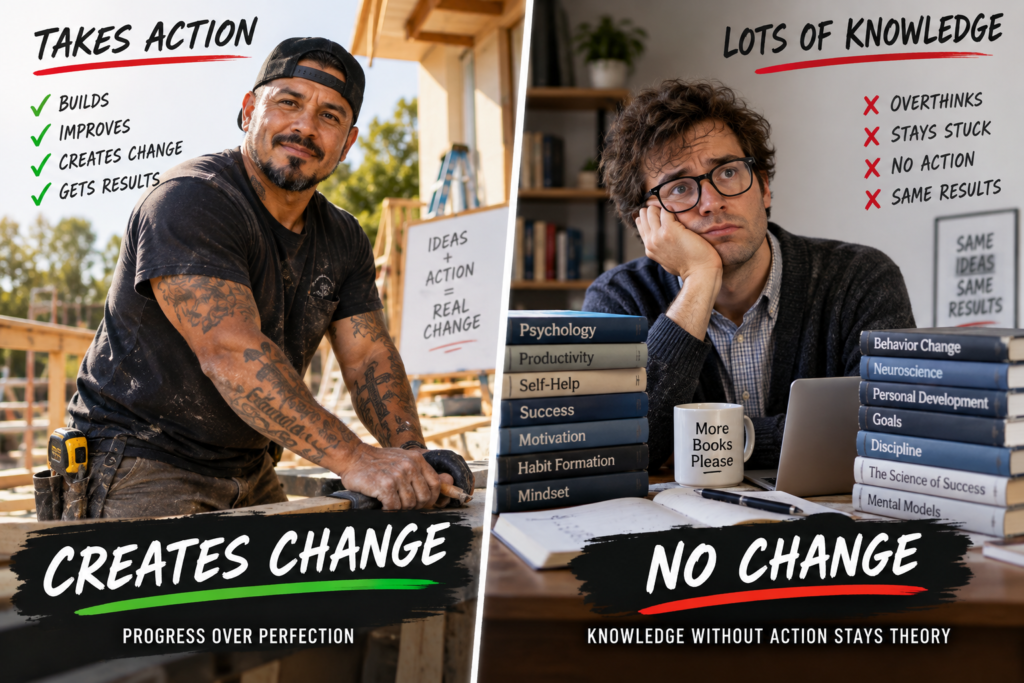
Why Personal Development Doesn’t Work: 7 Reasons Knowledge Alone Doesn’t Create Change
Have you ever finished a book, course, seminar or podcast feeling completely inspired?
Everything suddenly made sense.
You knew what you needed to do.
You promised yourself:
“This time I’m actually going to change.”
Then a week passed.
Work became busy.
Old routines returned.
The notes disappeared into a drawer.
The book went back on the shelf.
And your everyday behaviour gradually returned to almost exactly what it was before.
This experience creates an uncomfortable question:
Why doesn’t personal development work?
The problem is usually more complicated than saying personal development works or does not work.
A more useful question is:
Why does learning something important so often fail to create lasting behavioural change?
That distinction matters.
You can know how budgeting works and continue overspending.
You can understand exercise and remain inactive.
You can study communication and still become defensive during arguments.
You can understand procrastination while continuing to procrastinate.
You can listen to hours of motivational training and still avoid the one uncomfortable action that matters most.
In other words:
knowledge and change are not the same thing.
This is one of the most important themes running through Kevin Trudeau’s Your Wish Is Your Command, particularly his Teachability Index and Four Stages of Learning.
But the same problem is also recognised far beyond personal-development programs.
Behavioural research has repeatedly demonstrated a gap between what people intend to do and what they actually do.
This independent KevGuru guide explains seven major reasons personal-development knowledge fails to become behaviour — and, more importantly, what you can do differently.
Learning is only useful when something eventually changes.
Our practical Your Wish Is Your Command guide shows how to turn the major concepts into goals, plans and real-world action.
1. Does Personal Development Actually Work?
This question is too broad to answer with a simple yes or no.
“Personal development” can describe almost anything from:
- learning communication skills
- goal setting
- habit development
- meditation
- career training
- financial education
- motivational seminars
- manifestation programs
Some techniques have substantial supporting evidence.
Others have limited evidence.
Some are useful metaphors.
Others make claims that remain unproven.
And even an excellent technique can produce little change if someone never applies it.
Imagine receiving the world’s best exercise program.
You read every page.
Highlight important sections.
Watch every demonstration.
Understand exactly how each exercise works.
Then never exercise.
Was the information useless?
Not necessarily.
But:
information that never becomes behaviour cannot produce the behavioural result.
The same applies to much of personal development.
Before deciding that something “doesn’t work,” ask:
Did I actually apply it consistently enough to test it?
Then ask an equally important second question:
Did the technique itself produce measurable improvement when I applied it?
Both questions matter.
2. Knowing Something Is Not the Same as Doing It
Human beings can possess considerable knowledge while behaving inconsistently with that knowledge.
Most people already know that:
sleep matters
exercise matters
saving money matters
communication matters
practice matters
procrastination can create problems.
The missing information is often not:
“What should I do?”
The missing piece may instead be:
“How do I make myself reliably do what I already know matters?”
That is a self-regulation problem.
Suppose someone wants to study after work.
At 9:00 AM they sincerely intend to study that evening.
At 7:00 PM they arrive home tired.
The sofa is comfortable.
The phone is available.
Streaming entertainment requires almost no effort.
Tomorrow suddenly seems like a perfectly reasonable time to begin.
Nothing about the importance of studying changed.
But:
the immediate situation defeated the earlier intention.
That distinction is central to understanding why personal-development knowledge often fails to create change.
3. Reason #1: Learning Feels Like Progress
Learning can create a powerful sense of movement.
You buy a new book.
You organise your notes.
You watch three hours of training.
You download a worksheet.
You create a new folder.
You research another technique.
You feel productive.
But ask:
What changed outside your head?
Sometimes the answer is:
nothing yet.
This becomes particularly dangerous when consuming personal-development material itself becomes the habit.
You continually prepare to change.
You become exceptionally knowledgeable about change.
But you rarely remain with one behaviour long enough to actually change it.
For example:
Monday:
watch productivity video.
Tuesday:
download habit app.
Wednesday:
listen to motivational podcast.
Thursday:
read another system.
Friday:
research a completely different method.
There is constant activity.
But very little repetition.
The problem is not learning.
Learning is essential.
The problem is:
using additional learning to avoid practising what you have already learned.
A useful rule is:
Before consuming the next piece of personal-development content, identify one thing you have applied from the previous one.
4. Reason #2: The Goal Is Too Vague
Many personal-development goals sound meaningful but provide almost no behavioural guidance.
“I want to be successful.”
“I want more confidence.”
“I want financial freedom.”
“I want a better life.”
“I want better relationships.”
These may represent genuine desires.
But what do you actually do at 10:00 AM tomorrow?
That is where vague goals become difficult.
Compare:
“I want to become more confident.”
with:
“I will speak at the next team meeting instead of remaining silent.”
Compare:
“I want better finances.”
with:
“I will transfer $100 into savings every payday.”
Compare:
“I want to grow my business.”
with:
“I will speak with five potential customers this week.”
The second versions translate an aspiration into observable behaviour.
This connects directly with Desire in the Kevin Trudeau 4-Step Manifestation Formula.
Whatever you think about manifestation itself, clarity has an obvious practical benefit:
you cannot plan effectively around a goal you have never defined.
5. Reason #3: Good Intentions Are Not a Plan
Consider these statements:
“I am going to exercise more.”
“I am going to stop procrastinating.”
“I am going to save money.”
“I am going to work on my business.”
All sound positive.
None tells you precisely what happens next.
Behavioural research has documented what is often called the intention–behaviour gap.
People can genuinely intend to perform a behaviour and still fail to carry it out.
That means:
wanting to change is important — but wanting is not enough.
A plan needs to answer questions such as:
When?
Where?
What exactly?
What will I do if something gets in the way?
Instead of:
“I will exercise more.”
Try:
“At 6:30 PM on Monday, Wednesday and Friday, I will walk for 30 minutes.”
Better still, prepare for the predictable obstacle:
“If I arrive home tired and don’t want to walk, then I will change into my walking clothes and complete at least 10 minutes.”
Now the intention has become an action plan.
6. Reason #4: Old Habits and Environments Keep Winning
Personal development often concentrates heavily on motivation.
But behaviour is also influenced by context.
Think about checking your phone.
You may not consciously decide:
“It is now time to become distracted for 20 minutes.”
You see the phone.
You pick it up.
The behaviour begins.
Repeated behaviours can become increasingly associated with particular situations or cues.
That is one reason someone can sincerely want to change while repeatedly doing something else.
The old pathway is familiar.
The new behaviour requires more conscious effort.
This creates an important lesson:
Do not change only the person. Change the environment where possible.
If you want to study:
put the book on the desk before you need it.
If your phone continually interrupts you:
place it somewhere else.
If you want to save:
automate the transfer.
If you continually buy something unnecessarily because an app makes purchasing effortless:
remove the app or payment shortcut.
If you want to exercise in the morning:
prepare your clothes the night before.
Environment design does not eliminate personal responsibility.
It simply recognises that:
making the desired behaviour easier and the unwanted behaviour harder can improve your chances of following through.
7. Reason #5: The Required Action Is Too Big
Personal development frequently encourages ambitious thinking.
That can be motivating.
But the size of the dream and the size of today’s action are different questions.
Imagine writing:
“Build a successful business.”
Your brain now has an enormous project.
Where do you start?
Website?
Logo?
Company structure?
Product?
Advertising?
Pricing?
Sales?
Accounting?
The complexity itself can create avoidance.
Instead ask:
What is the next useful action?
Perhaps:
“Speak with one potential customer.”
That action is small enough to perform.
But important enough to produce information.
The same principle applies elsewhere.
Instead of:
“Get fit.”
Try:
“Walk for 15 minutes.”
Instead of:
“Repair my relationship.”
Try:
“Ask my partner if we can have a calm 20-minute conversation tonight.”
Instead of:
“Become financially organised.”
Try:
“Review the last seven days of spending.”
The smaller action is not the final goal.
It is the doorway into movement.
8. Reason #6: Part of You May Resist the Change
This is where Kevin Trudeau’s concept of Counter Intentions becomes relevant.
Trudeau suggests that people can consciously want one outcome while holding another internal belief that works against it.
For example:
“I want a promotion.”
But:
“If I become a manager, everyone will expect more from me.”
Or:
“I want a successful business.”
But:
“If the business becomes successful, I will lose my freedom.”
Psychology does not need Trudeau’s specific Counter Intention terminology to recognise that people can have competing goals, fears and motivations.
A useful question is:
What might achieving this goal cost me?
Possible answers include:
time
comfort
certainty
privacy
social approval
familiarity
free time
the ability to blame circumstances.
That does not mean you have discovered a mysterious hidden program.
It means you have identified a conflict worth examining.
Sometimes resistance is not:
“I don’t want the goal.”
It is:
“I want the goal, but I also want to avoid something the goal requires.”
That distinction can be extremely useful.
Learning More Isn’t Always the Next Step
If you already understand the concepts, our practical YWIYC guide shows how to turn Desire, Belief, Expectancy, obstacles and action into an everyday system.
9. Reason #7: You Never Measure Whether Anything Changed
Feeling inspired is not the same as producing change.
Feeling confident is not always evidence that skill improved.
Feeling “aligned” is not evidence that the external strategy is working.
So measure something.
If you are trying to save money:
How much did you actually save?
If you are developing a business:
How many customers did you speak with?
If you are learning:
How many practice sessions did you complete?
If you are job hunting:
How many appropriate applications did you submit?
If you are improving communication:
Did you actually practise the behaviour you selected?
Measurement creates feedback.
Without feedback, you can continue applying an ineffective approach indefinitely while believing:
“I just need to believe harder.”
Sometimes the correct response is:
change the strategy.
Personal development should improve your interaction with reality.
It should not protect your ideas from reality.
10. The Teachability Index Explains Part of the Problem
Kevin Trudeau’s Teachability Index is particularly relevant to the knowledge-action gap.
His framework asks about two things:
Willingness to Learn
and
Willingness to Change.
Those can be very different.
Imagine someone who constantly studies investing but refuses to examine their spending.
Or someone who reads relationship books but refuses to apologise.
Or someone who attends business seminars but never speaks with customers.
They may love learning.
But change requires something different.
Sometimes change requires:
being uncomfortable
admitting you were wrong
becoming a beginner
trying something uncertain
breaking a routine
receiving feedback
failing publicly.
That is why:
being teachable is not simply enjoying information.
The real test begins when the information asks you to behave differently.
11. The Four Stages of Learning Explain Another Part
The Four Stages of Learning provide another useful perspective.
The stages are commonly described as:
- Unconscious Incompetence
- Conscious Incompetence
- Conscious Competence
- Unconscious Competence
Personal-development content can move you from:
“I didn’t realise I had this problem.”
to:
“Now I can see exactly what I am doing wrong.”
That is progress.
But it can feel worse.
Why?
Because awareness arrived before competence.
You now recognise mistakes you previously did not notice.
This is where many people abandon change.
They conclude:
“This isn’t working.”
But they may actually have moved into Conscious Incompetence.
The next phase requires practice.
Then deliberate performance.
Then repetition.
The lesson is:
awareness is the beginning of change, not evidence that change is complete.
12. Why Motivation Is Not Enough
Motivation matters.
But motivation changes.
You can feel highly motivated on Sunday night.
Monday becomes difficult.
Tuesday brings an unexpected problem.
Wednesday you are tired.
Thursday the goal feels less exciting.
If your plan depends on always feeling inspired:
your plan is fragile.
This is why systems matter.
Instead of:
“I will exercise when I feel motivated.”
Try:
“Monday, Wednesday and Friday at 6:30 PM.”
Instead of:
“I will work on my business when inspiration strikes.”
Try:
“Tuesday morning from 8:00 to 9:00 is prospecting time.”
Motivation may help begin a behaviour.
Structure helps protect it when motivation disappears.
13. The Intention–Behaviour Gap
The difference between intending to act and actually acting has been studied extensively.
Researchers have found that even strong intentions do not guarantee behaviour.
That explains an experience almost everyone recognises.
You genuinely meant to:
exercise
study
save
call someone
finish the project
apply for the job.
You were not lying to yourself when you formed the intention.
But later:
something happened between intention and execution.
A research review on implementation intentions describes this intention–behaviour gap and examines strategies designed specifically to reduce it.
You can read the research here:
Research Review: Translating Intentions Into Action.
This gives personal-development readers an important lesson:
Do not mistake a strong decision for completed behaviour.
14. The Power of If–Then Planning
One practical strategy for bridging the gap is known as an implementation intention.
The format is:
If situation X occurs, then I will perform behaviour Y.
For example:
If I arrive home and want to skip studying,
then I will study for 15 minutes before opening social media.
Or:
If I receive my salary,
then $200 will immediately transfer into savings.
Or:
If I become defensive during an important conversation,
then I will pause and ask one question before responding.
The advantage is that you decide what to do:
before the difficult moment arrives.
That matters.
Your calm Monday-morning self can prepare your tired Monday-night self.
Implementation intentions have been studied across many goal domains and are specifically designed to help turn intentions into action.
This does not guarantee success.
But it is much more concrete than:
“I must try harder.”
15. Why Repetition Matters More Than One Powerful Insight
Sometimes one insight genuinely changes a person’s direction.
But lasting behavioural change often involves repetition.
Habit research describes habits as behaviours increasingly triggered by contextual cues after repeated performance.
That means:
you normally do not create automaticity merely by understanding something.
You create the new pathway by performing the behaviour.
Then performing it again.
And again.
Importantly, there is no universal rule that every habit takes exactly 21 days.
A recent systematic review found considerable variation in how long habit formation can take depending on the behaviour, person and context.
You can read that research here:
Systematic Review and Meta-Analysis of Habit Formation.
The practical lesson is simple:
stop asking only whether you understand the new behaviour.
Ask:
How can I make repeating it easier?
16. The KevGuru Knowledge-to-Change Method
Here is a simple five-stage system for turning something you learn into something you actually use.
1. LEARN
Understand the idea.
What did I learn?
2. CHOOSE
Select one behaviour that should change because of what you learned.
What will I do differently?
3. PLAN
Define when and where the behaviour will occur.
When exactly will I do it?
4. REPEAT
Perform the behaviour often enough for it to become easier and more familiar.
How can I make repetition easier?
5. MEASURE
Observe the result and adjust if necessary.
Is this actually helping?
17. A Money Example
Suppose someone reads a financial book and learns:
“Pay yourself first.”
They agree.
Highlight the sentence.
Tell a friend how powerful the idea is.
But nothing changes.
Knowledge has occurred.
Behaviour has not.
Now apply our method.
LEARN
Saving before discretionary spending can help protect the money from being spent elsewhere.
CHOOSE
Save $150 every payday.
PLAN
Set an automatic bank transfer for the morning salary arrives.
REPEAT
Allow it to occur every payday.
MEASURE
Review the savings balance after three months.
The insight did not change the finances.
The system connected to the insight did.
18. A Career and Business Example
Suppose someone attends a sales seminar.
They learn:
“Businesses need more conversations with suitable potential customers.”
They return home excited.
Then spend three weeks improving their logo.
Again:
knowledge without behavioural alignment.
Apply the method.
LEARN
Customer conversations matter.
CHOOSE
Speak with five appropriate prospects every week.
PLAN
Tuesday and Thursday mornings from 9:00 to 10:00.
REPEAT
Maintain the process for eight weeks.
MEASURE
Track:
prospects contacted
conversations
proposals
sales
objections.
Now the training produces data.
If nobody responds:
change the approach.
If conversations happen but nobody buys:
investigate the offer.
If customers buy:
identify what worked.
That is learning connected to reality.
19. A Relationship Example
Suppose someone learns:
“Listen before becoming defensive.”
Excellent advice.
Then an argument begins.
Their emotional reaction appears before they remember the book.
This illustrates why intellectual understanding is not enough.
The behaviour needs rehearsal.
Try an if–then plan:
“If I feel myself becoming defensive, then I will ask one clarifying question before explaining my position.”
Now practise.
At first it may feel unnatural.
That is expected.
Eventually the response may become easier.
This illustrates the journey from:
knowing
to
deliberate behaviour
to
greater automaticity.
20. When Personal Development Becomes Procrastination
This deserves special attention.
Personal development can look extremely productive while becoming a sophisticated form of avoidance.
You may tell yourself:
“I need one more course before I start.”
“I need another book.”
“I need to understand myself better.”
“I need to get completely aligned.”
“I need to eliminate every limiting belief first.”
“I need to feel more confident.”
Sometimes those things genuinely matter.
But ask:
What action am I avoiding while I continue preparing?
If you want to start a business, perhaps it is contacting a customer.
If you want a career change, perhaps it is submitting the application.
If you want to improve a relationship, perhaps it is beginning the uncomfortable conversation.
If you want to write, perhaps it is opening the document.
At some point:
preparation must become participation.
21. How to Tell Whether a Course Is Actually Helping You
Instead of asking only:
“Did I enjoy it?”
or:
“Did it inspire me?”
ask better questions.
Did I learn something I didn’t previously understand?
Did the information change a decision?
Did I change a behaviour?
Did I practise that behaviour?
Did anything measurable improve?
Did the course help me identify an incorrect assumption?
Did it help me stop an unhelpful behaviour?
Did it help me make better decisions?
A course does not have to transform your entire life to be worthwhile.
Sometimes one useful idea can justify the time spent learning it.
But:
the value should eventually extend beyond the emotional experience of consuming the content.

The KevGuru View
So why doesn’t personal development work?
Sometimes the teaching itself is poor.
Sometimes a claim is unsupported.
Sometimes the advice is inappropriate for the person’s circumstances.
But there is another reason that deserves far more attention:
learning and changing are different processes.
You can learn in minutes.
Changing behaviour may require:
practice
repetition
planning
feedback
discomfort
mistakes
adjustment
time.
That explains why personal development can become addictive.
The learning stage feels good.
It creates novelty.
Hope.
Insight.
Possibility.
Application is less glamorous.
Application means:
doing the budget.
making the call.
having the conversation.
practising the skill.
going for the walk.
sending the application.
trying again after an uncomfortable result.
This is also why the Teachability Index remains one of the more practically useful ideas within Your Wish Is Your Command.
Willingness to learn is only half the equation.
Eventually you have to become willing to do something differently.
KevGuru’s recommendation is therefore:
Learn less randomly.
Apply more deliberately.
Choose one behaviour.
Make the next action small.
Plan for the obstacle.
Repeat.
Measure.
Adjust.
And before opening the next book, course or podcast, ask yourself one uncomfortable but valuable question:
“What have I actually changed because of the last thing I learned?”
That question may be worth more than another hundred pages of information.
Turn the Ideas Into Action
The current Free Your Wish offer includes the Your Wish Is Your Command Event Recording and Ebook at $0. If you explore the training, try selecting one idea at a time and testing how it affects your actual behaviour.
GET YOUR WISH IS YOUR COMMAND FREE
You will leave KevGuru and be taken to the current external offer. Optional additional offers may appear and can be declined.
Recommended Resources
- How to Apply Your Wish Is Your Command in Everyday Life
- Your Wish Is Your Command – Independent Beginner’s Guide
- Teachability Index Explained
- Four Stages of Learning Explained
- Kevin Trudeau Counter Intentions Explained
- Training Balance Scale Explained
- Kevin Trudeau 4-Step Manifestation Formula Explained
- Who Do You Listen To? 7 Rules for Choosing Better Advice
- Get Your Wish Is Your Command Free
- KevGuru Affiliate Disclosure
- Scientific Review: Turning Intentions Into Action With If–Then Planning
- Scientific Review: Habit Formation, Repetition and Automaticity
- Meta-Analysis: Mental Contrasting and Implementation Intentions