
How to Study Your Wish Is Your Command: Powerful 14-Lesson Guide
You can listen to Your Wish Is Your Command from beginning to end.
You can enjoy the stories.
You can highlight interesting ideas.
You can feel inspired.
And a month later, you may remember surprisingly little of what you heard.
That does not necessarily mean the program was useless.
It may mean you consumed the training as entertainment instead of studying it as something you intended to remember, evaluate and apply.
That distinction is important.
Kevin Trudeau himself describes Your Wish Is Your Command as training rather than passive entertainment and encourages repeated exposure to the material.
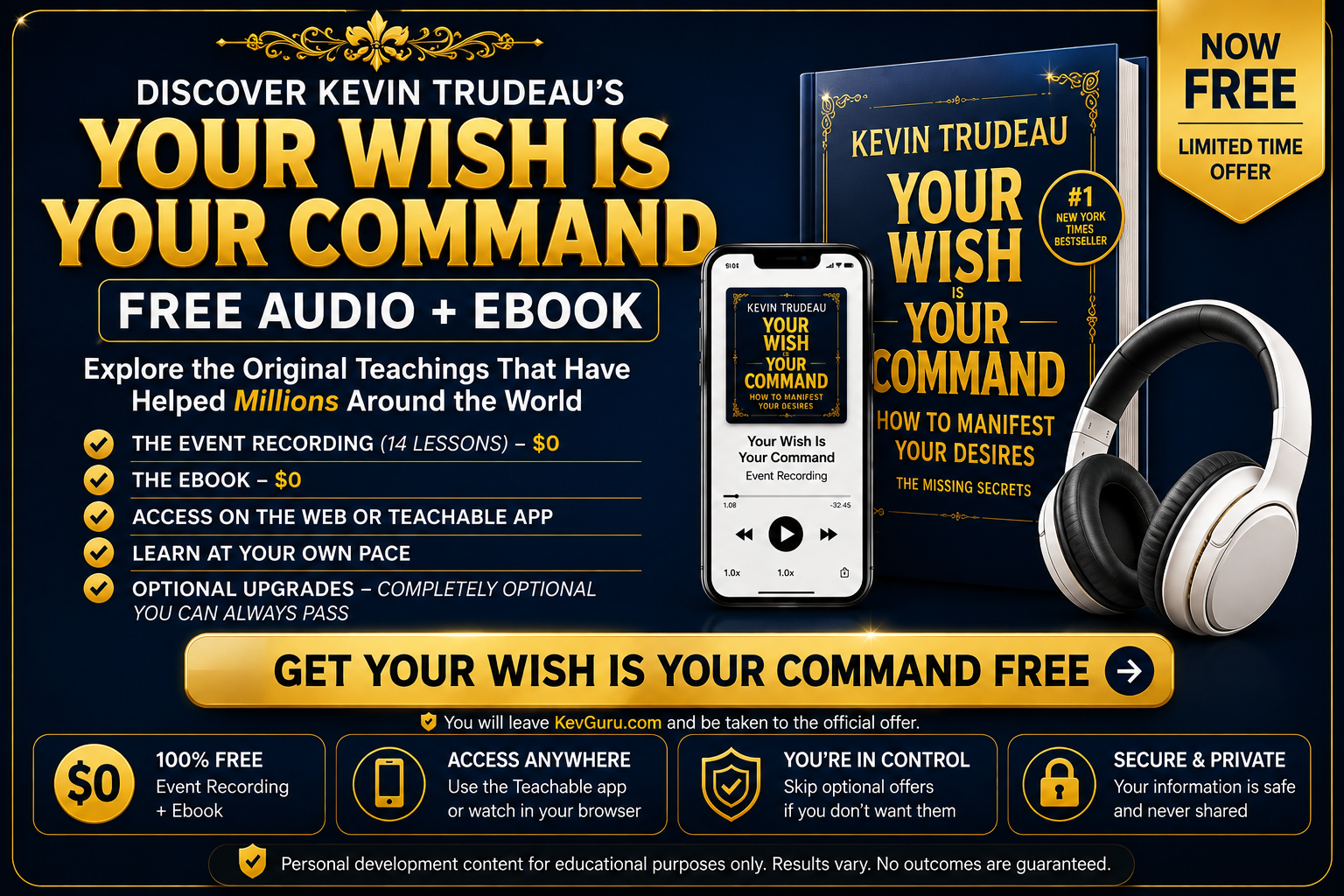
The current Event Recording available through the Free Your Wish offer is presented as a 14-lesson training program.
So instead of asking:
“How quickly can I finish all 14 lessons?”
a much better question is:
“How much can I understand, remember, evaluate and actually use?”
This KevGuru guide will show you how to study Your Wish Is Your Command using a practical system built around:
- active listening
- retrieval practice
- spaced review
- critical thinking
- personal examples
- one-action-per-lesson
- weekly reflection
- real-world testing
You do not need to accept every claim Kevin Trudeau makes.
In fact, studying the program properly means learning to separate:
what Trudeau teaches
from
what you personally conclude after thinking about it and testing what can reasonably be tested.
That is how information becomes useful rather than merely memorable.
Need access to the training before using this study system?
The current Free Your Wish offer includes the Your Wish Is Your Command Event Recording and Ebook at $0.
1. Should You Study YWIYC or Just Listen to It?
There is nothing wrong with listening casually the first time.
In fact, that can be useful.
A first exposure helps you understand the structure, language and major ideas.
But if your goal is to remember and apply the material, passive listening alone has limitations.
Imagine listening while:
- checking your phone
- answering messages
- driving through heavy traffic
- working
- scrolling social media
You technically heard the lesson.
But how much did you process?
Kevin Trudeau’s current material specifically describes YWIYC as training rather than entertainment and recommends repeated engagement with the material.
You can read his current overview here:
Kevin Trudeau’s current Your Wish Is Your Command guide.
KevGuru’s recommendation is therefore:
First listen for understanding.
Then:
study for retention, evaluation and application.
2. Why Listening Once Is Usually Not Enough
Memory fades.
That is normal.
You may understand something perfectly while listening and later discover that you cannot explain it clearly without returning to the source.
There is also a psychological trap.
Something can feel familiar without being genuinely retrievable.
You hear:
“Teachability Index.”
You think:
“Yes, I know that.”
But close the material and ask:
What are its two components?
How are they different?
How would I apply them today?
Suddenly the difference between:
recognising information
and
knowing information
becomes obvious.
Learning research consistently finds that actively retrieving information from memory can strengthen long-term retention more effectively than repeatedly exposing yourself to the same material.
So do not measure learning by:
“That sounds familiar.”
Measure it by:
“Can I explain this without looking?”
3. Don’t Binge All 14 Lessons
The temptation is understandable.
You receive access.
You are excited.
You want everything immediately.
So you listen to:
Lesson 1.
Lesson 2.
Lesson 3.
Lesson 4.
And eventually:
Lesson 14.
Finishing quickly can feel productive.
But finishing is not the same as learning.
Research on spaced practice consistently shows advantages to distributing learning over time rather than concentrating everything into one large session.
A major review of learning science identifies spaced practice as one of several strategies with substantial experimental support.
You can read that review here:
Teaching the Science of Learning.
The lesson is not:
“Never listen to two lessons on the same day.”
There is no universal perfect schedule.
The practical lesson is:
give your brain opportunities to forget slightly, retrieve and reconnect the material over time.
KevGuru therefore recommends studying YWIYC as a sequence rather than a race.
4. The KevGuru Three-Pass Learning Method
Here is the system I recommend.
For each lesson, use three passes.
PASS 1 — UNDERSTAND
Listen to the lesson and identify the main message.
PASS 2 — RETRIEVE
Before replaying it, try to recall the important concepts from memory.
PASS 3 — APPLY & EVALUATE
Connect the lesson with your own life, decide what you agree or disagree with, and choose one useful action or experiment.
This prevents you from repeatedly consuming information without processing it.
5. Pass One: Understand the Big Idea
On the first pass, do not attempt to write down every sentence.
Your goal is:
understanding.
At the end of the lesson, answer one question:
“If I had to explain the main point of this lesson in three sentences, what would I say?”
Write those sentences.
Then identify:
The most important concept:
____________________________
The most interesting example:
____________________________
The thing I most want clarified:
____________________________
That is enough for the first pass.
Avoid turning your notes into a transcript.
If you write everything, you may spend more mental energy copying than thinking.
6. Pass Two: Retrieve Before You Replay
This is one of the biggest improvements you can make to your study process.
Before replaying the lesson:
do not look at your notes.
Take a blank page.
Write:
“What do I remember?”
Then list everything you can recall.
Try to reconstruct:
- the main idea
- important terminology
- examples
- the relationship with earlier lessons
- anything you disagreed with
- anything you wanted to apply
Only after attempting retrieval should you return to the material.
Now compare.
What did you remember correctly?
What did you forget?
What did you misunderstand?
What seemed important during the lesson but vanished from memory?
This is much more revealing than simply pressing Play again.
7. Pass Three: Apply and Evaluate
This is where study becomes personal development.
For each major idea, ask:
What does this mean in my life?
Suppose the lesson involves the Teachability Index.
Do not stop at:
“I understand willingness to learn and willingness to change.”
Ask:
Where am I currently learning but refusing to change?
Suppose the lesson involves Counter Intentions.
Ask:
Is there any repeated behaviour actually working against one of my goals?
Suppose the lesson involves expectancy.
Ask:
What do I genuinely expect to happen with my current goal?
Then evaluate the teaching itself.
Ask:
Is this a useful practical principle?
Is this Kevin Trudeau’s interpretation?
Is this a scientific claim?
What evidence would I need before accepting the stronger version?
Studying well does not mean agreeing with everything.
It means understanding accurately before deciding what you think.
8. The Best Notes to Take During YWIYC
I recommend dividing your notes into three columns.
| WHAT TRUDEAU TEACHES | MY INTERPRETATION | WHAT I WILL DO / TEST |
|---|---|---|
| Write the principle accurately. | Explain what you think it means. | Choose an action, question or experiment. |
| Example: willingness to change matters. | Learning without behaviour change can become passive consumption. | Identify one behaviour I will change this week. |
| Example: Counter Intentions may oppose a conscious goal. | Look for conflicting beliefs or behaviours without assuming a hidden cause. | Use the KevGuru belief audit on one goal. |
This prevents three things from becoming mixed together:
the original teaching
your interpretation
and
your application.
That is especially valuable when studying personal-development material containing both practical and metaphysical claims.
9. The Five Questions to Answer After Every Lesson
You can simplify the entire study system into five questions.
THE FIVE-QUESTION YWIYC REVIEW
1. What is the most important idea in this lesson?
____________________________________________
2. Can I explain it in my own words?
____________________________________________
3. Where does this show up in my own life?
____________________________________________
4. What part do I question or want to verify?
____________________________________________
5. What is one thing I will do differently because of this lesson?
____________________________________________
If you answer those five questions after all 14 lessons, you will have created something much more useful than a pile of highlighted notes.
10. Why Retrieval Beats Constant Re-Listening
One of the strongest findings in learning research concerns retrieval practice.
Retrieval means trying to bring information back from memory.
For example:
Instead of replaying the Teachability Index explanation immediately, close everything and ask:
What are the two components?
How are they measured?
What is the practical idea?
What criticism would I make?
This effort can feel harder than replaying the lesson.
That difficulty is often useful.
A review of the testing effect notes that retrieving information can improve later retention compared with simply restudying it.
You can explore that research here:
Scientific Review of Retrieval Practice and the Testing Effect.
Another real-world systematic review found benefits from retrieval practice and distributed practice across many educational studies.
Systematic Review of Distributed and Retrieval Practice.
The practical lesson:
sometimes struggling to remember is more useful than immediately being shown the answer.
Don’t Just Finish the Training — Build Something From It
Our practical YWIYC guide shows how to turn the concepts you study into goals, behavioural experiments and everyday action.
11. How to Use Spaced Review
You do not need a complicated algorithm.
You simply need to stop reviewing everything at exactly the same moment you originally learned it.
Here is a simple KevGuru schedule you can experiment with.
Immediately after the lesson
Write your three-sentence summary.
The following day
Retrieve the main ideas without notes.
Approximately three days later
Answer the five review questions again.
Approximately one week later
Explain the lesson aloud without looking.
Approximately two weeks later
Review only the parts you struggled to remember or apply.
These are not scientifically established “perfect intervals.”
Optimal spacing depends on the material, learner and desired retention period.
The underlying principle is what matters:
spread review over time rather than concentrating all exposure into one session.
Research reviews consistently find that spaced repetitions can improve longer-term retention compared with massed repetition.
Scientific Review of the Spacing Effect.
12. Use One Real-Life Example for Every Major Principle
Abstract concepts become easier to understand when connected to concrete examples.
Suppose the concept is:
Counter Intentions.
Do not write only the definition.
Create an example:
“I say I want a promotion, but I keep avoiding leadership opportunities because I worry greater responsibility will consume my free time.”
Concept:
Teachability Index.
Example:
“I keep reading financial books but have not changed my spending system.”
Concept:
Expectancy.
Example:
“I believe a career change is possible, but I currently expect employers to reject me.”
The example forces you to explain the idea.
It also helps reveal whether you genuinely understand it.
13. Use the One-Action-Per-Lesson Rule
This may be the most important rule in the article.
After every lesson, choose:
ONE ACTION.
Not five.
Not twenty.
One.
It may be:
write one goal clearly
have one conversation
review one belief
change one automatic transfer
remove one distraction
practise one skill
contact one potential customer
ask one better question.
Why only one?
Because studying can easily become another form of procrastination.
The purpose is not to prove that every YWIYC principle works.
The purpose is to ensure that:
learning repeatedly connects with behaviour.
This links directly with our article:
Why Personal Development Doesn’t Work: Why Knowledge Alone Doesn’t Create Change.
14. Keep Trudeau’s Claims Separate From Your Conclusions
This is particularly important with Your Wish Is Your Command.
Some ideas can be interpreted using familiar behavioural concepts.
Others contain metaphysical claims.
Suppose Kevin Trudeau says:
theta allows subconscious programming related to manifestation.
Your notes should not automatically become:
“Theta scientifically programs manifestation.”
Instead write:
WHAT TRUDEAU TEACHES:
Trudeau gives theta a special role in accessing and influencing deeper mental patterns.
WHAT RESEARCH SUPPORTS:
Theta-band activity is real and has relationships with areas such as memory, cognitive control, drowsiness, meditation and some hypnosis findings.
WHAT REMAINS UNPROVEN:
Science does not currently establish that theta brainwaves give thoughts special power to manifest external events.
We examine this distinction in:
Kevin Trudeau Theta State: What Science Really Says.
This is how you remain both:
open-minded
and
critical.
15. How to Study Counter Intentions
When you reach material involving Counter Intentions, avoid hunting for dramatic subconscious explanations.
Choose one goal.
Then ask:
What behaviour repeatedly works against this goal?
Example:
Goal:
build savings.
Behaviour:
spend unexpected income immediately.
Now ask:
What thought usually appears?
Perhaps:
“I deserve to enjoy this money.”
Then:
What belief might contribute?
Perhaps:
“Saving means depriving myself.”
Now test the assumption.
Could you:
save part
spend part
and observe what happens?
This is considerably more practical than simply declaring:
“I found a money block.”
16. How to Study the Teachability Index
The Teachability Index should not simply become another definition you memorise.
Use it.
Ask:
Willingness to Learn: 1–10
How open am I to receiving information that challenges what I currently believe?
Then:
Willingness to Change: 1–10
How willing am I to behave differently if the evidence suggests I should?
Then identify one example.
Perhaps:
“I repeatedly read about productivity but still allow notifications to interrupt every work session.”
The lesson is now connected with real behaviour.
Whether or not you accept Trudeau’s numerical scoring as scientifically validated, the underlying self-reflection question can still be valuable:
Am I merely collecting information, or am I willing to change?
17. How to Study Desire, Belief, Expectancy and Action
When studying the 4-Step Manifestation Formula, choose one real goal.
Then create four headings.
DESIRE
What exactly do I want?
BELIEF
Do I believe I can perform the behaviours necessary to pursue it?
EXPECTANCY
What result do I genuinely expect based on my current situation and behaviour?
ACTION
What is the next useful thing I can actually do?
This turns an abstract manifestation framework into something you can examine.
It also gives you a way to distinguish:
the practical goal-setting interpretation
from
the broader metaphysical claims surrounding manifestation.
18. Your 14-Lesson Study Tracker
Here is a simple tracker for the current 14-lesson Event Recording.
Do not worry if the lesson structure or access format changes in the future.
Use the same system with whatever current version you have.
| Lesson | Main Idea | Recall Done? | One Action | Reviewed? |
|---|---|---|---|---|
| 1 | ________ | □ | ________ | □ |
| 2 | ________ | □ | ________ | □ |
| 3 | ________ | □ | ________ | □ |
| 4 | ________ | □ | ________ | □ |
| 5 | ________ | □ | ________ | □ |
| 6 | ________ | □ | ________ | □ |
| 7 | ________ | □ | ________ | □ |
| 8 | ________ | □ | ________ | □ |
| 9 | ________ | □ | ________ | □ |
| 10 | ________ | □ | ________ | □ |
| 11 | ________ | □ | ________ | □ |
| 12 | ________ | □ | ________ | □ |
| 13 | ________ | □ | ________ | □ |
| 14 | ________ | □ | ________ | □ |
The important column is not:
“Completed?”
It is:
“One Action.”
19. A Simple Weekly Review
At the end of each week, do not immediately move on.
Spend 15–20 minutes reviewing.
Ask:
WEEKLY YWIYC STUDY REVIEW
What were the three most important ideas I learned?
1. ____________________________________________
2. ____________________________________________
3. ____________________________________________
Which idea can I explain without notes?
____________________________________________
Which idea do I still not understand?
____________________________________________
What did I actually apply?
____________________________________________
What happened when I applied it?
____________________________________________
What claim do I want to investigate further?
____________________________________________
What will I focus on next week?
____________________________________________
Now your study process contains feedback rather than endless forward motion.
20. Build Your Personal YWIYC Operating Manual
After completing all 14 lessons, do not leave yourself with 100 pages of random notes.
Create one final document.
Call it:
MY YWIYC OPERATING MANUAL
Keep it short.
Perhaps three to five pages.
Include:
My Most Important Principles
What five ideas were genuinely useful?
My Current Goal
What exactly am I working toward?
My Important Beliefs
Which assumptions appear to help or interfere?
My Counter-Patterns
What behaviours repeatedly work against my goals?
My Action Rules
What have I decided to do consistently?
My If–Then Plans
What will I do when predictable obstacles appear?
My Evidence Questions
Which claims do I accept?
Which remain uncertain?
Which do I reject?
My Weekly Review
What will I measure?
This is where the training becomes yours.
Not because you copied Kevin Trudeau’s words.
But because you:
understood → evaluated → selected → applied.
21. Seven Study Mistakes to Avoid
1. Binge-listening simply to finish
Completion is not retention.
2. Writing down everything
Notes should support thinking, not become a transcript.
3. Replaying before trying to remember
Attempt retrieval first.
4. Treating familiarity as mastery
If you cannot explain it without notes, continue learning.
5. Accepting every claim automatically
Understand the claim first, then evaluate it.
6. Studying without applying anything
Use the one-action-per-lesson rule.
7. Starting another personal-development program immediately afterwards
Give yourself time to apply what you have already learned.
The last mistake is particularly important.
Your goal should not become:
consume every Kevin Trudeau program.
It should be:
identify which ideas improve your life and behaviour, then actually use them.
The KevGuru View
If someone asked KevGuru:
“What is the best way to study Your Wish Is Your Command?”
our answer would not be:
“Listen to it as many times as possible.”
Repetition can help.
But repetition without thinking can become background noise.
A stronger system is:
LISTEN.
Understand the lesson.
CLOSE IT.
Try to remember it.
EXPLAIN IT.
Put it into your own words.
QUESTION IT.
Separate evidence, interpretation and claims.
CONNECT IT.
Find an example from your life.
APPLY IT.
Choose one behaviour.
REVIEW IT.
Return after time has passed.
MEASURE IT.
See whether anything useful changes.
Then repeat.
The goal of studying personal development should not be to become a person who knows enormous amounts about personal development.
The goal should be:
to understand yourself better and make better decisions in the life you are actually living.
If one YWIYC lesson changes one important behaviour for the better, that may be more valuable than remembering every sentence in all fourteen.
So don’t ask only:
“Have I finished the training?”
Ask:
“What can I now explain?”
“What have I questioned?”
“What have I tested?”
and most importantly:
“What have I actually changed?”
Ready to Study the Training for Yourself?
The current Free Your Wish offer includes the Your Wish Is Your Command Event Recording and Ebook at $0. The Event Recording is currently presented as a 14-lesson program, making it easy to use the lesson-by-lesson system above.
GET YOUR WISH IS YOUR COMMAND FREE
You will leave KevGuru and be taken to the current external offer. Optional additional offers may appear and can be declined. Offer details and access methods may change.
Frequently Asked Questions About Studying Your Wish Is Your Command
How should I study Your Wish Is Your Command?
KevGuru recommends using three stages for each lesson: first understand the lesson, then retrieve the key ideas from memory before replaying it, and finally apply and evaluate one important concept.
How many lessons are in Your Wish Is Your Command?
The current Event Recording available through the Free Your Wish offer is presented as a 14-lesson training program.
The original program was also distributed as a 14-CD audio series.
Offer formats can change, so always check the current training area.
Should I listen to all 14 lessons quickly?
You can, but if your aim is long-term learning rather than simply finishing the program, spreading study and review over time may improve retention.
How many times should I listen to Your Wish Is Your Command?
Kevin Trudeau’s current material encourages multiple passes through the training.
KevGuru recommends focusing less on a fixed number and more on whether you can retrieve, explain, evaluate and apply the important concepts.
Should I take notes while listening?
Yes, but avoid attempting to transcribe everything.
Record the major idea, your interpretation, questions and one possible action.
What is retrieval practice?
Retrieval practice means trying to recall information from memory rather than immediately returning to the source.
For example, after a YWIYC lesson, close your notes and write everything you remember before replaying it.
What is spaced practice?
Spaced practice means distributing learning and review across time rather than doing all repetitions together in one intensive session.
Research generally supports spaced learning for longer-term retention.
Should I believe everything Kevin Trudeau says before applying the program?
No.
You can understand a teaching accurately without automatically accepting every claim.
KevGuru recommends separating the original teaching, your interpretation and supporting evidence.
Should I study the Ebook and Event Recording together?
They can complement each other.
Audio can convey tone and explanation, while written material can be easier to review, annotate and reference.
Use whichever format helps you understand and retrieve the material most effectively.
How much should I apply from each lesson?
KevGuru recommends starting with one useful action or experiment per lesson.
This prevents information overload and makes it easier to see whether an idea changes behaviour.
How do I know if I really understand a lesson?
Try explaining it aloud in your own words without looking at the source.
Then create a real-life example and answer a question about how you would apply or challenge the principle.
Do I have to accept the manifestation claims to benefit from studying YWIYC?
No.
You can examine individual concepts such as learning, beliefs, expectations, Counter Intentions, goal clarity and action independently of the broader metaphysical claims.
What should I do after finishing all 14 lessons?
Build a short personal operating manual containing the most useful ideas, your current goals, important beliefs, action rules, predictable obstacles and what you want to continue testing.
Recommended Resources
- How to Apply Your Wish Is Your Command in Everyday Life
- Your Wish Is Your Command – Independent Beginner’s Guide
- Teachability Index Explained
- Four Stages of Learning Explained
- How to Identify Beliefs Working Against Your Goals
- Kevin Trudeau Counter Intentions Explained
- Kevin Trudeau 4-Step Manifestation Formula Explained
- Kevin Trudeau Theta State Explained
- Why Personal Development Doesn’t Work
- How to Access Your Wish Is Your Command: Teachable, Browser & 14 Lessons
- Get Your Wish Is Your Command Free
- KevGuru Affiliate Disclosure
- Kevin Trudeau’s Current YWIYC Guide
- Scientific Review: Six Evidence-Based Learning Strategies
- Scientific Review: Retrieval Practice and the Testing Effect
- Systematic Review: Spaced and Retrieval Practice