7 Proven Strategies for Overcoming Limiting Beliefs and Personal Growth

Many confidence challenges are rooted in limiting beliefs. Learning to identify and replace these beliefs can create powerful changes in personal growth, confidence, and success.
Achieving meaningful personal growth often requires more than hard work, motivation, or goal setting. Despite having clear ambitions and a genuine desire to improve their lives, some individuals continue to experience self-doubt, procrastination, fear of failure, and difficulty reaching their full potential.
In many situations, the real challenge is not a lack of ability, intelligence, or opportunity. Instead, the obstacle is often a set of limiting beliefs that quietly influence thoughts, decisions, and behaviours. These beliefs can shape how people view themselves, what they believe is possible, and the actions they are willing to take.
Overcoming limiting beliefs is one of the most important steps in personal development because beliefs influence behaviour, and behaviour influences results. When individuals identify and challenge beliefs that no longer serve them, they often discover new opportunities for growth, confidence, success, and fulfilment.
The process of overcoming limiting beliefs is not about pretending challenges do not exist. It is about recognising that many perceived limitations are based on assumptions rather than facts. By replacing limiting beliefs with more empowering perspectives, it becomes possible to develop greater resilience, stronger self-belief, and a mindset that supports long-term success.
This guide explores what limiting beliefs are, how they develop, and practical strategies for overcoming limiting beliefs so you can create positive change, strengthen confidence, and achieve greater personal growth.
Table of Contents
What Are Limiting Beliefs?
Limiting beliefs are thoughts, assumptions, or convictions that restrict what we believe is possible for ourselves. These beliefs can influence how we think, feel, and behave, often without us realizing it.
A limiting belief may sound like:
• I am not good enough.
• I will never be successful.
• I am too old to change.
• I am not smart enough.
• People like me never get ahead.
• I do not deserve happiness or success.
While these beliefs may feel true, they are often based on past experiences, misunderstandings, or repeated messages received from others rather than objective reality.
The challenge with limiting beliefs is that they often become self-fulfilling. When people believe they cannot succeed, they may avoid opportunities, hesitate to take action, or give up too quickly, which then reinforces the belief.
Understanding and overcoming limiting beliefs allows individuals to replace self-imposed limitations with more empowering perspectives that support growth and achievement.
How Limiting Beliefs Develop
Limiting beliefs often develop over many years and can be influenced by a variety of factors, including childhood experiences, family expectations, education, social environments, and past failures.
For example, a child who is repeatedly told they are not capable may begin to believe that message and carry it into adulthood. Similarly, a person who experiences repeated setbacks may develop beliefs that success is unattainable or that failure is inevitable.
Media, cultural influences, and comparisons with others can also contribute to limiting beliefs. Over time, these messages may become deeply rooted and begin to shape decisions, habits, and expectations.
The good news is that beliefs are learned, which means they can also be changed. Recognising where a belief came from is often the first step toward overcoming it and creating a more positive and empowering mindset.
"The beliefs you reinforce today become the reality you experience tomorrow. Change your beliefs, and your actions—and results—begin to change with them."
Kevin Trudeau's Teaching Tweet
The Building Blocks of Personal Growth
Lasting personal growth begins by replacing limiting beliefs with empowering habits and consistent action.
| Growth Habit | How It Helps |
|---|---|
| Self-Awareness | Recognises limiting beliefs before they influence decisions. |
| Courage | Builds confidence by taking action despite uncertainty. |
| Consistency | Creates lasting change through repeated positive habits. |
| Growth Mindset | Encourages learning rather than fearing mistakes. |
| Personal Responsibility | Keeps your focus on what you can control and improve. |
Every positive belief you strengthen makes the next empowering decision easier.
Common Examples of Limiting Beliefs
Limiting beliefs can affect virtually every area of life. Some of the most common examples include:
Financial Beliefs
• I will never have enough money.
• Wealthy people are greedy.
• I am not good with money.
Career Beliefs
• I am not qualified enough.
• I will never get promoted.
• Successful people are simply lucky.
Relationship Beliefs
• I am not worthy of love.
• Healthy relationships never last.
• People will eventually disappoint me.
Personal Growth Beliefs
• I cannot change.
• I always fail.
• I am not confident enough.
Identifying these patterns is an important part of overcoming limiting beliefs because awareness creates the opportunity for change.
7 Strategies for Overcoming Limiting Beliefs
1. Identify the Belief
The first step in overcoming limiting beliefs is identifying them. Many people are unaware of the beliefs influencing their decisions because these thoughts have become automatic over time.
Pay attention to recurring thoughts that arise when you consider a goal or opportunity. Statements such as “I can’t do that,” “I’m not good enough,” or “People like me never succeed” may reveal underlying limiting beliefs.
Writing these thoughts down can be helpful because it allows you to examine them objectively. Once a belief is identified, it becomes easier to challenge and replace.
2. Question the Evidence
Many limiting beliefs feel true because they have been repeated for years. However, feelings are not always facts. Ask yourself whether there is genuine evidence supporting the belief.
For example, if you believe you always fail, consider examples where you succeeded, learned a new skill, or overcame a challenge. Most people quickly discover that their limiting beliefs are based on selective memories rather than objective reality.
Questioning the evidence helps weaken the belief and creates space for a more balanced perspective.
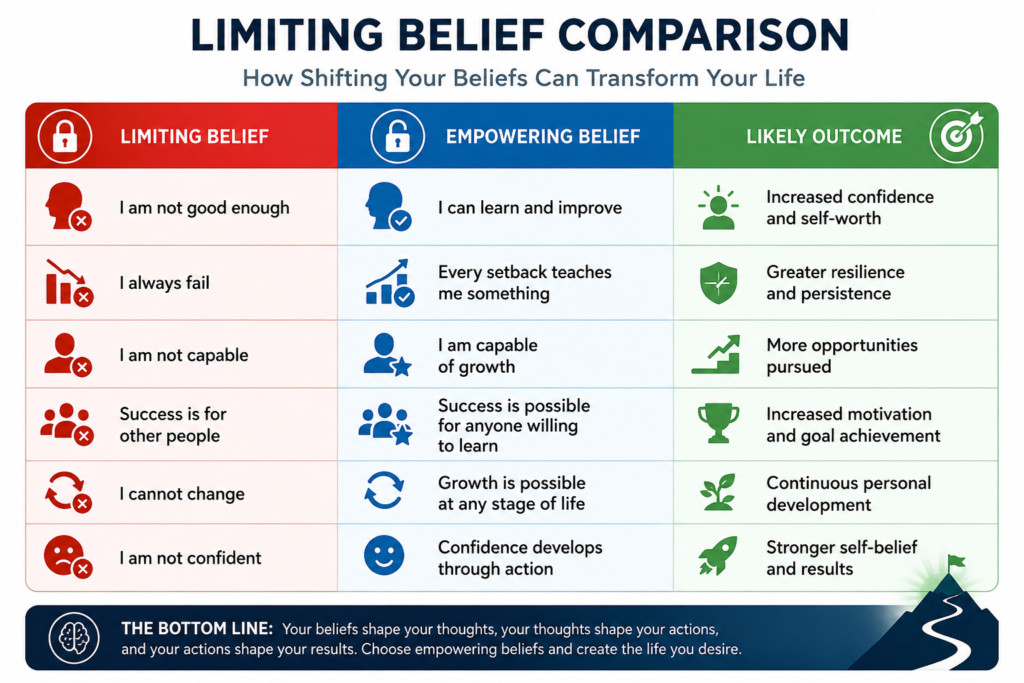
3. Replace Negative Beliefs with Empowering Beliefs
Once a limiting belief has been identified and challenged, it is important to replace it with a more empowering alternative.
Instead of saying:
• I am not capable.
Try:
• I am capable of learning and improving.
Instead of:
• I always fail.
Try:
• Every setback helps me learn and grow.
The goal is not to create unrealistic affirmations but to adopt beliefs that encourage action, growth, and resilience.
4. Take Small Actions That Challenge the Belief
Action is one of the most effective ways to overcome limiting beliefs. Each time you take action that contradicts a limiting belief, you create new evidence that the belief may not be true.
For example, someone who believes they are not confident may challenge that belief by speaking up in a meeting, introducing themselves to new people, or learning a new skill.
Small actions performed consistently often create significant shifts in confidence and self-belief over time.
5. Learn from Successful People
Many successful individuals have overcome significant obstacles, self-doubt, and limiting beliefs on their path to success. Reading biographies, listening to interviews, and studying personal development can provide valuable perspective.
When people see others overcoming similar challenges, it becomes easier to believe that change is possible. These examples can help replace limiting beliefs with greater optimism and possibility.
6. Surround Yourself with Positive Influences
The people you spend time with can significantly influence your beliefs, attitudes, and expectations. Supportive individuals often encourage growth, provide constructive feedback, and inspire confidence, while negative influences can reinforce self-doubt and limiting beliefs.
Take time to evaluate the people, media, and environments that shape your thinking. Surrounding yourself with positive influences does not mean avoiding challenges or criticism. It means choosing relationships and resources that encourage learning, growth, and personal development.
Many people find that their confidence and motivation improve when they spend more time with individuals who believe in their potential and support their goals.
7. Practice Self-Reflection and Growth
Overcoming limiting beliefs is not a one-time event. It is an ongoing process of self-awareness, reflection, and growth. As you progress through life, new challenges may reveal additional beliefs that need to be examined and updated.
Regular self-reflection can help identify patterns of thinking that may be holding you back. Journaling, personal development exercises, coaching, and honest self-assessment can all support this process.
The more aware you become of your thoughts and behaviours, the easier it becomes to replace limiting beliefs with empowering beliefs that support long-term success and personal fulfilment.
The Connection Between Beliefs and Success
Beliefs influence actions, and actions influence results. For this reason, the beliefs people hold about themselves often have a significant impact on their level of success in life.
Individuals who believe they are capable of learning, growing, and overcoming challenges are generally more willing to take action and persist when difficulties arise. In contrast, limiting beliefs can create hesitation, fear, and avoidance that prevent people from reaching their full potential.
Overcoming limiting beliefs does not guarantee immediate success, but it can remove many of the mental barriers that prevent progress. As empowering beliefs replace limiting ones, people often become more confident, resilient, and willing to pursue opportunities that support their goals.
Limiting Beliefs Comparison Table
Recommended Resources for Personal Growth
If you found this guide helpful, the resources below can help you continue overcoming limiting beliefs, strengthening self-confidence, and building a mindset that supports lasting personal growth.
• How to Build Self-Confidence Naturally: 10 Proven Strategies for Personal Growth
• How to Build Personal Power: 9 Practical Ways to Feel More Confident and in Control
• What Is Personal Empowerment? 7 Ways to Take Control of Your Life
• Why Goal Achievement Matters More Than Goal Setting
• 7 Powerful Success Habits of Highly Successful People
• 11 Signs You Are Holding Yourself Back (And How to Break Free)
Related Kevin Trudeau Programs
• Superpower Processes: 9 Powerful Benefits of Kevin Trudeau’s Live Training
• Accelerator Processes: 9 Powerful Benefits of Kevin Trudeau’s Live Training
• Money Processes: 9 Powerful Benefits of Kevin Trudeau’s Live Training
• Kevin Trudeau Products: 11 Popular Programs Reviewed in 2026
Additional Learning Resources
External Resources
Frequently Asked Questions
Q: What are limiting beliefs?
A: Limiting beliefs are thoughts, assumptions, or convictions that restrict what people believe is possible for themselves. These beliefs can influence decisions, actions, confidence, and overall success.
Q: Why do limiting beliefs develop?
A: Limiting beliefs often develop through childhood experiences, social influences, education, family expectations, past failures, and repeated messages received over time.
Q: Can limiting beliefs be changed?
A: Yes. Limiting beliefs are learned patterns of thinking, which means they can be challenged, replaced, and improved through self-awareness, personal development, and consistent action.
Q: What is the first step in overcoming limiting beliefs?
A: The first step is identifying the belief. Once a limiting belief becomes visible, it is easier to examine the evidence supporting it and replace it with a more empowering perspective.
Q: How long does it take to overcome limiting beliefs?
A: The timeframe varies for each individual. Some beliefs can shift quickly, while deeply rooted beliefs may require ongoing reflection, practice, and personal growth over an extended period.
Q: Can limiting beliefs affect confidence?
A: Yes. Limiting beliefs often contribute to self-doubt, fear of failure, and reduced confidence. Overcoming limiting beliefs can significantly improve self-belief and personal effectiveness.
Q: What role does personal development play in overcoming limiting beliefs?
A: Personal development helps individuals increase self-awareness, challenge negative thinking patterns, develop new skills, and build empowering beliefs that support growth and success.
Limiting Beliefs Self-Assessment
Answer Yes or No.
• Do you doubt yourself before trying something new?
• Do you avoid opportunities because you fear failure?
• Do you compare yourself negatively with other people?
• Do you regularly tell yourself “I’m not good enough”?
• Do you procrastinate because you’re afraid of making mistakes?
• Do you often expect the worst outcome?
• Do you struggle to accept compliments?
• Do you believe success comes more easily to everyone else?
If you answered “Yes” to four or more questions, limiting beliefs may be influencing your decisions more than you realise. Developing greater self-awareness is often the first step toward lasting personal growth.
Break Free From Limiting Beliefs
Need a Flexible Payment Option?
Many participants choose a payment plan so they can begin their personal development journey sooner. Explore the available payment options and choose the plan that best supports your goals.
Final Thoughts
Overcoming limiting beliefs is one of the most valuable investments you can make in your personal growth journey. The beliefs you hold about yourself influence your decisions, actions, and ultimately the results you create in life.
While limiting beliefs may feel permanent, they are often learned patterns that can be changed. By identifying unhelpful beliefs, questioning their validity, and replacing them with more empowering perspectives, you can create greater confidence, resilience, and opportunity.
Remember that growth rarely happens overnight. Every small step you take toward challenging a limiting belief helps create evidence that change is possible.
The goal is not perfection. The goal is progress. As you continue learning, growing, and taking action, you may discover that many of the limitations you once believed were real were simply beliefs waiting to be replaced.
Your future is not defined by your limiting beliefs. It is shaped by the choices you make and the beliefs you choose to strengthen moving forward.