How to Remove Money Blocks and Create Financial Success

Many people work hard, develop valuable skills, and pursue opportunities to improve their financial situation. Yet despite their efforts, they often find themselves struggling to achieve the level of success, wealth, or financial freedom they desire.
While external factors can influence financial outcomes, many experts believe that internal beliefs and attitudes also play an important role. Negative thoughts about money, success, and self-worth can influence decision-making, risk tolerance, confidence, and the willingness to pursue opportunities.
These hidden mental barriers are often referred to as money blocks. They can affect financial behaviour without individuals even realising it, making it more difficult to achieve financial goals and create lasting wealth.
This guide explores what money blocks are, how they develop, and practical strategies that can help you build a healthier relationship with money and create greater financial success.
Table of Contents
What Are Money Blocks?
Money blocks are limiting beliefs, attitudes, or emotional patterns that can interfere with a person’s ability to earn, save, invest, or manage money effectively.
These beliefs often develop through life experiences, family influences, cultural messages, education, and personal observations. Over time, they can become deeply ingrained and influence financial decisions without conscious awareness.
Examples of common money blocks include believing that wealthy people are greedy, feeling unworthy of financial success, fearing failure, fearing success, or assuming that financial security is impossible to achieve.
Because beliefs influence behaviour, these patterns can affect financial outcomes and create challenges that persist even when opportunities for improvement exist.
"Financial success begins long before money appears in your bank account. It starts with the beliefs, habits, and decisions you choose to strengthen every day."
Kevin Trudeau's Teaching Tweet
Why Money Blocks Matter
Financial success is influenced by more than income alone. Mindset, habits, confidence, and decision-making all contribute to long-term financial outcomes.
When limiting beliefs about money remain unchallenged, they can influence spending habits, career decisions, business opportunities, investments, and personal motivation. Individuals may avoid opportunities, underestimate their value, or make decisions based on fear rather than possibility.
By identifying and addressing money blocks, people can begin developing healthier financial habits, greater confidence, and a more constructive approach to wealth creation and financial growth.
The Foundations of Financial Success
Long-term financial success is often built through consistent habits rather than one-time events.
| Financial Habit | Why It Matters |
|---|---|
| Financial Awareness | Recognises habits and beliefs that influence money decisions. |
| Opportunity Recognition | Helps identify opportunities that others may overlook. |
| Consistency | Small financial improvements compound over time. |
| Personal Responsibility | Encourages proactive financial decision-making. |
| Continuous Learning | Builds confidence and improves long-term financial outcomes. |
Greater financial awareness creates better decisions, and better decisions often lead to better financial outcomes.
7 Common Money Blocks and How to Overcome Them
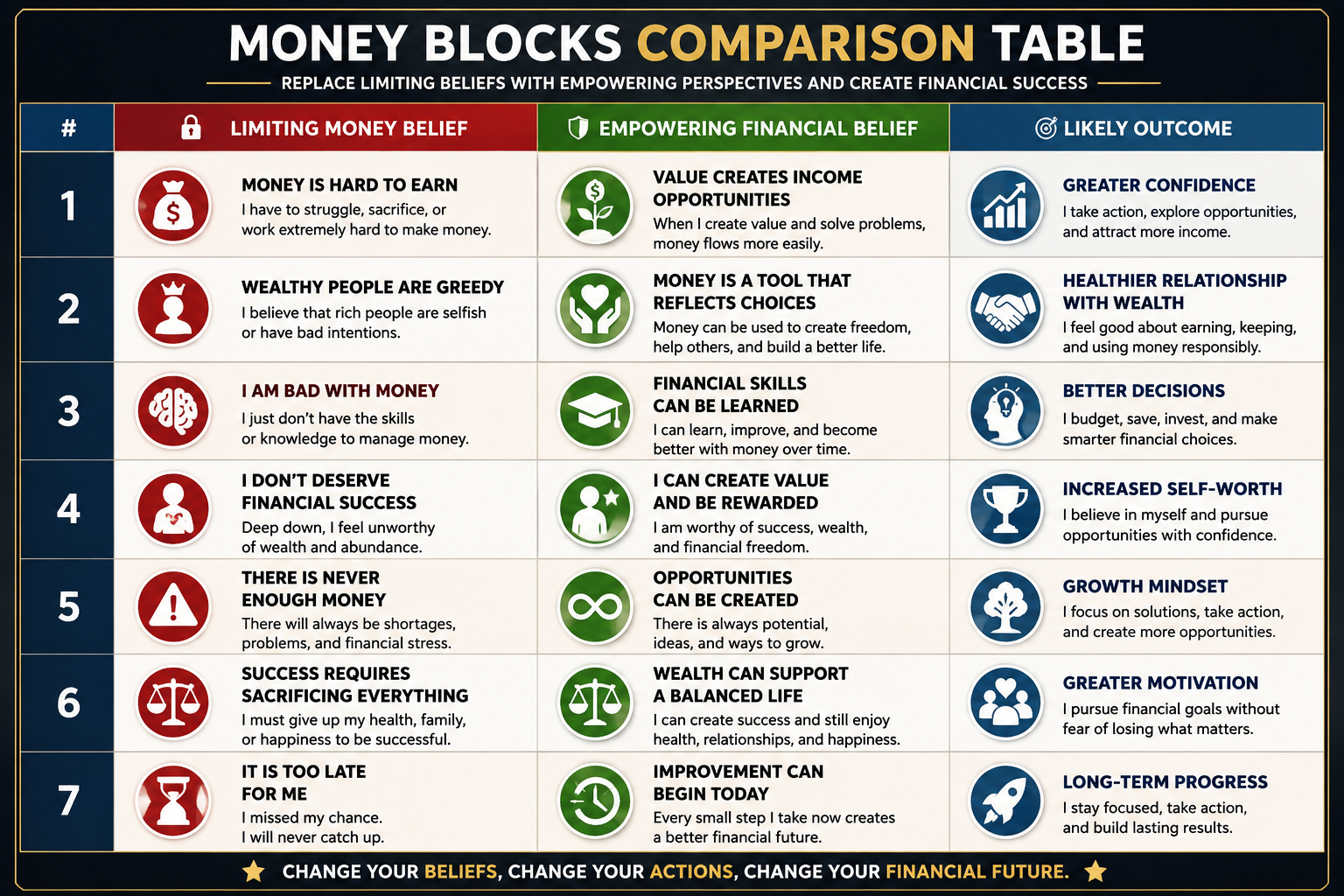
1. Money Is Hard to Earn
One of the most common money blocks is the belief that earning money must always involve struggle, sacrifice, or excessive hard work. While effort is often required to achieve financial success, believing that money can only come through hardship may limit your ability to recognise opportunities that create value more efficiently.
Individuals who hold this belief may overlook opportunities for innovation, investing, business ownership, or skill development because they assume financial success must always be difficult.
A healthier perspective is to focus on creating value, solving problems, and developing skills that allow you to increase your income while improving the quality of your life.
2. Wealthy People Are Greedy
Many people grow up hearing negative messages about wealth and successful individuals. While some people may misuse money, financial success itself is not a reflection of character.
Believing that wealth is inherently negative can create an internal conflict where individuals desire financial success while simultaneously associating it with undesirable traits.
A more balanced perspective is to recognise that money is simply a tool. It can be used to create opportunities, support family, contribute to communities, and help others when managed responsibly.
3. I Am Not Good with Money
Many individuals develop the belief that they are naturally bad with money because of past mistakes or limited financial education. Unfortunately, this belief can become a self-fulfilling prophecy if it discourages learning and improvement.
Financial skills are not fixed traits. Budgeting, investing, saving, and wealth-building strategies can all be learned through education and experience.
Replacing this belief with a commitment to learning can create significant improvements in financial confidence and decision-making over time.
4. I Don't Deserve Financial Success
Feelings of unworthiness can affect many areas of life, including finances. Some individuals unconsciously believe they are not deserving of wealth, success, or financial security.
These beliefs may develop through childhood experiences, criticism, comparisons, or negative self-talk. Over time, they can influence career choices, pricing decisions, negotiation confidence, and willingness to pursue opportunities.
Recognising your value and focusing on the positive contributions you make can help develop a healthier and more empowering relationship with financial success.
5. There Is Never Enough Money
A scarcity mindset focuses attention on limitations, shortages, and fear of loss. While financial challenges are real, constantly focusing on scarcity can reduce confidence and limit creative problem-solving.
People who operate from scarcity often avoid calculated risks, delay important decisions, or become overly focused on protecting what they have rather than creating new opportunities.
Developing a more abundant perspective encourages individuals to focus on growth, learning, opportunity, and long-term wealth creation rather than constant fear of shortage.
6. Success Means Sacrificing Everything
Some people believe that achieving financial success requires sacrificing relationships, health, happiness, or personal values. While building wealth often requires effort and discipline, it does not necessarily require abandoning the things that matter most.
This belief can create resistance to financial growth because individuals may subconsciously avoid success in order to protect other important areas of life.
A healthier perspective is to view financial success as something that can support a balanced and fulfilling life. Wealth can provide freedom, flexibility, security, and opportunities that improve overall wellbeing when managed wisely.
7. I Am Too Late to Become Financially Successful
Many people believe they missed their opportunity to improve their financial situation. They compare themselves to others and assume that because they did not start earlier, success is no longer possible.
While starting early can provide advantages, financial improvement can occur at any stage of life. New skills can be learned, opportunities can be created, and better financial habits can be developed regardless of age or background.
Focusing on what you can do today is often far more productive than dwelling on what could have been done in the past. Consistent action taken now can create meaningful results over time.
Money Blocks Comparison Table
Recommended Resources for Financial Growth
Improving your financial situation often begins by changing the way you think about money, opportunity, abundance, and long-term wealth creation. The resources below will help you continue developing a stronger money mindset and greater financial awareness.
• Money Processes: 9 Powerful Benefits of Kevin Trudeau’s Live Training
• Money Programming Explained: How Your Childhood Beliefs About Money Shape Your Financial Future
• Financial Self-Sabotage: 9 Powerful Signs Hidden Patterns Are Holding You Back
• Wealth Consciousness Explained: Why Some People Attract Money More Easily Than Others
• Counter Intentions Explained: 7 Dangerous Causes of Self-Sabotage
• 7 Signs Your Money Mindset Is Changing (Even If You Haven’t Made More Money Yet)
Related Money Mindset Articles
• What Is a Wealth Mindset? How to Think Like Wealthy People
• Abundance Mindset vs Scarcity Mindset: Key Differences Explained
• Why Some People Stay Financially Stuck: 9 Hidden Patterns That Keep People Broke
• Why Hard Work Alone Doesn’t Create Wealth: The Missing Piece Most People Never Learn
• 7 Common Money Mistakes: Why Smart People Stay Broke
Related Kevin Trudeau Programs
• Superpower Processes: 9 Powerful Benefits of Kevin Trudeau’s Live Training
• Accelerator Processes: 9 Powerful Benefits of Kevin Trudeau’s Live Training
• Kevin Trudeau Products: 11 Popular Programs Reviewed in 2026
Additional Learning Resources
External Resources
Financial success is rarely created by one breakthrough. It is usually the result of greater awareness, better decisions, stronger habits, continuous learning, and consistent action over time.
Frequently Asked Questions
Q: What are money blocks?
A: Money blocks are limiting beliefs, emotional patterns, or attitudes that can negatively influence financial decisions and reduce confidence around money and wealth.
Q: Can money blocks affect financial success?
A: Yes. Beliefs often influence behaviour. Limiting beliefs can affect career decisions, spending habits, risk tolerance, confidence, and willingness to pursue opportunities.
Q: How do money blocks develop?
A: They often develop through childhood experiences, family influences, education, cultural messages, and personal experiences related to money and success.
Q: Can money blocks be removed?
A: Limiting beliefs can be identified, challenged, and replaced with more constructive perspectives through self-awareness, learning, and consistent practice.
Q: What is the first step to overcoming money blocks?
A: The first step is recognising the beliefs that may be influencing your financial decisions. Once identified, those beliefs can be evaluated and replaced with healthier alternatives.
Money Mindset Self-Assessment
Answer Yes or No.
• Do you worry about money more often than you feel confident about it?
• Do you hesitate to invest in yourself?
• Do you believe wealth is difficult to achieve?
• Do you often miss opportunities because you doubt yourself?
• Do financial setbacks affect your confidence for long periods?
• Do you believe successful people are simply luckier?
• Do you find yourself repeating the same financial mistakes?
• Do you feel uncomfortable discussing money?
If you answered “Yes” to four or more questions, money blocks or limiting financial beliefs may be influencing your financial decisions more than you realise.
Develop Greater Financial Awareness
Need a Flexible Payment Option?
Many participants choose a payment plan so they can begin improving their financial mindset and personal development sooner. Explore the available payment options and choose the plan that best supports your goals.
Final Thoughts
Money blocks can quietly influence financial decisions for years without being recognised. They often shape behaviours, confidence levels, and perceptions of what is possible.
The good news is that beliefs are not permanent. By becoming aware of limiting financial beliefs and replacing them with more empowering perspectives, individuals can develop healthier habits, stronger confidence, and greater financial resilience.
Financial success is not determined solely by income. It is also influenced by mindset, behaviour, learning, and the willingness to take action.
Every positive financial decision, no matter how small, contributes to long-term progress. The journey toward greater financial success often begins with changing the way you think about money and the opportunities available to you.
Keep learning. Keep growing. Keep moving forward.
And may your future shine as brightly as the flame within you.