What Is Personal Empowerment? 7 Ways to Take Control of Your Life
Taking control of your life often begins with recognising that your choices, actions, and mindset have a powerful influence on your future. While circumstances can affect outcomes, individuals who develop confidence, self-awareness, and responsibility are often better equipped to navigate challenges and create meaningful change.
People who feel in control of their decisions tend to be more resilient, motivated, and willing to pursue opportunities for growth. Rather than waiting for conditions to be perfect, they focus on what they can influence and take consistent action toward their goals.
Developing a stronger sense of personal control is not about managing every aspect of life. It is about understanding your strengths, accepting responsibility for your actions, and building the confidence to move forward even when uncertainty exists.
This guide explores how greater self-belief, responsibility, and confidence can help you create positive change, improve decision-making, and achieve long-term personal growth and success.
Table of Contents
What Is Personal Empowerment?
Personal empowerment refers to the ability to take greater control of your thoughts, decisions, and actions while developing the confidence to shape your future. It involves increasing self-awareness, accepting responsibility for your choices, and making decisions that align with your values and long-term goals.
Individuals who develop this mindset understand that challenges and setbacks are a natural part of life. Rather than blaming circumstances or waiting for someone else to create change, they focus on what they can influence and take consistent action toward growth and improvement.
Developing confidence, overcoming limiting beliefs, improving decision-making, and building valuable life skills are all important parts of becoming more empowered. These qualities help individuals navigate uncertainty, pursue meaningful goals, and create positive change in their lives.
As self-belief and resilience grow, people often become more willing to embrace opportunities, take calculated risks, and pursue the outcomes they genuinely want to achieve.
Why Personal Empowerment Matters
The ability to take control of your decisions and actions can influence nearly every area of life, including confidence, relationships, career development, financial choices, health, and overall wellbeing.
Individuals who believe they can influence outcomes are generally more likely to set goals, take action, overcome obstacles, and remain committed to growth. They tend to focus on solutions rather than problems and are often better equipped to navigate uncertainty and change.
Developing greater self-belief can also improve confidence because it reinforces the understanding that your actions matter and that consistent effort can create positive results over time.
For this reason, empowerment is often viewed as one of the most important foundations for long-term success, resilience, and personal fulfilment. When individuals recognise their ability to learn, adapt, and grow, they are more likely to pursue opportunities that support a meaningful and rewarding life.
"Personal empowerment begins the moment you realise that the direction of your future is shaped by the decisions you make today."
Kevin Trudeau's Teaching Tweet
7 Ways to Develop Personal Empowerment
1. Take Responsibility for Your Decisions
Taking responsibility for your decisions is one of the most important steps toward creating positive change. While circumstances can influence outcomes, successful individuals understand that they still have choices regarding how they respond to challenges and opportunities.
Accepting responsibility does not mean blaming yourself for every setback. Instead, it means focusing on the areas of life you can influence and taking ownership of the actions that move you closer to your goals.
As people develop this mindset, they often become more confident, proactive, and resilient because they recognise their ability to influence their future through consistent action.
2. Build Self-Confidence Through Action
Confidence is rarely developed through thinking alone. It grows through action, experience, and the willingness to step outside your comfort zone.
Each challenge you overcome, skill you learn, and goal you achieve provides evidence that you are capable of growth and improvement. These experiences gradually strengthen self-belief and create momentum for future success.
Rather than waiting until you feel ready, focus on taking small actions that build confidence over time. Progress often creates confidence more effectively than confidence creates progress.
3. Overcome Limiting Beliefs
The beliefs you hold about yourself influence the decisions you make and the opportunities you pursue. Negative assumptions such as “I am not capable” or “I will never succeed” can quietly restrict personal growth and achievement.
Learning to question these beliefs can open the door to new possibilities. Ask yourself whether there is genuine evidence supporting the belief or whether it is simply a conclusion formed from past experiences.
Replacing limiting thoughts with more constructive perspectives often helps individuals become more willing to take action, learn new skills, and pursue meaningful goals.
4. Develop a Growth Mindset
A growth mindset is the belief that abilities, knowledge, and skills can be improved through effort, learning, and experience. This perspective encourages individuals to view challenges as opportunities to learn rather than reasons to quit.
People who adopt a growth mindset tend to be more resilient because they understand that setbacks are part of the learning process. They focus on improvement rather than perfection and are more willing to persist when difficulties arise.
By embracing continuous learning and self-improvement, individuals create a foundation for long-term success and personal development.
5. Set Meaningful Goals
Goals provide direction, motivation, and a sense of purpose. Without clear goals, it is easy to become distracted or lose focus on what truly matters.
Meaningful goals encourage consistent action and create opportunities to experience progress. Each milestone achieved strengthens confidence and reinforces the belief that your actions can produce positive results.
The most effective goals are aligned with your values, broken into manageable steps, and supported by regular action. Small wins often lead to significant achievements over time.
6. Surround Yourself with Positive Influences
The people, environments, and information sources that surround you can have a significant impact on your mindset and behaviour. Supportive individuals often encourage growth, provide valuable feedback, and inspire confidence during difficult times.
While it is impossible to avoid all negativity, intentionally seeking positive influences can help strengthen motivation and maintain focus on your goals.
Spending time with people who value learning, growth, and personal development often creates an environment that encourages progress and achievement.
7. Commit to Lifelong Learning
Continuous learning is one of the most effective ways to increase confidence, adaptability, and independence. Every new skill, lesson, and experience expands your ability to solve problems and pursue opportunities.
Whether through books, courses, mentors, or practical experience, learning helps individuals adapt to change and make better decisions throughout life.
The commitment to lifelong learning reinforces the belief that growth is always possible and that improvement can continue regardless of age, background, or current circumstances.
Key Elements of Personal Empowerment
Personal empowerment is built by developing habits and qualities that strengthen your ability to make confident decisions and create positive change.
| Personal Quality | How It Helps |
|---|---|
| Self-Awareness | Recognises behaviours, beliefs, and opportunities for growth. |
| Confidence | Encourages decisive action and resilience. |
| Personal Responsibility | Promotes ownership of decisions and outcomes. |
| Consistency | Builds momentum through positive daily habits. |
| Continuous Learning | Supports ongoing personal and professional growth. |
Personal empowerment grows when confidence, responsibility, and consistent action work together.
The Connection Between Personal Empowerment and Success
Personal empowerment and success are closely connected because empowered individuals are more likely to take action, pursue opportunities, and persist through challenges.
Success is rarely determined by talent alone. Confidence, resilience, self-belief, and consistent action often play an equally important role. Empowered individuals tend to focus on solutions, take responsibility for their growth, and maintain momentum even when facing setbacks.
Developing personal empowerment does not guarantee immediate success, but it increases the likelihood of achieving meaningful goals because it strengthens the mindset and behaviours that support long-term achievement.
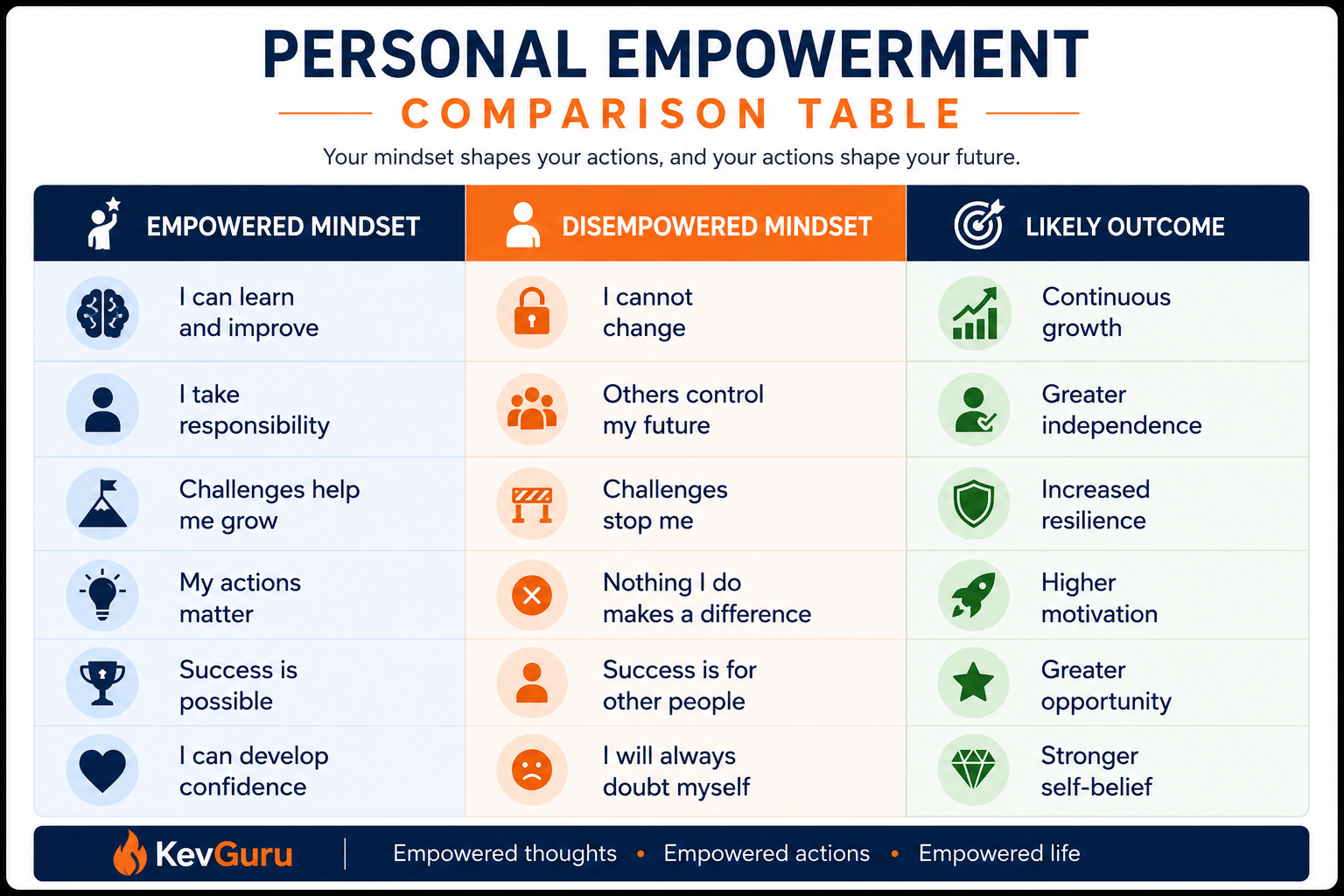
Personal Empowerment Comparison Table
Recommended Resources for Personal Empowerment
Personal empowerment is developed through self-awareness, confidence, responsibility, and consistent action. The resources below will help you strengthen your mindset, unlock your potential, and take greater control of your life.
• Negative Thinking: 14 Hidden Ways It May Be Affecting Your Success
• How to Build Personal Power: 9 Practical Ways to Feel More Confident and in Control
• How to Build Self-Confidence Naturally: 10 Proven Strategies for Personal Growth
• 7 Proven Strategies for Overcoming Limiting Beliefs and Personal Growth
• Why Successful People Think Differently: 7 Success Mindset Habits
• Why Goal Achievement Matters More Than Goal Setting
• 11 Signs You Are Holding Yourself Back (And How to Break Free)
Related Personal Growth Articles
• 7 Powerful Success Habits of Highly Successful People
• Goal Setting: 9 Powerful Strategies to Achieve Your Goals Faster
• Superpower Processes: 9 Powerful Benefits of Kevin Trudeau’s Live Training
• Accelerator Processes: 9 Powerful Benefits of Kevin Trudeau’s Live Training
Related Kevin Trudeau Programs
• Money Processes: 9 Powerful Benefits of Kevin Trudeau’s Live Training
• Kevin Trudeau Products: 11 Popular Programs Reviewed in 2026
Additional Learning Resources
External Resources
Frequently Asked Questions
Q: What is personal empowerment?
A: Personal empowerment is the ability to take control of your thoughts, decisions, actions, and future. It involves developing confidence, self-awareness, responsibility, and the belief that your actions can influence positive outcomes.
Q: Why is personal empowerment important?
A: Personal empowerment helps individuals develop confidence, improve decision-making, overcome challenges, and pursue meaningful goals. It is closely connected to personal growth, resilience, and long-term success.
Q: Can personal empowerment be learned?
A: Yes. Personal empowerment is a skill that can be developed through self-awareness, continuous learning, confidence-building activities, and consistent action. Like any skill, it becomes stronger with practice.
Q: How does personal empowerment improve confidence?
A: Personal empowerment encourages individuals to take responsibility for their actions and recognise their ability to create change. As people achieve goals and overcome challenges, confidence naturally grows.
Q: What is the relationship between personal empowerment and personal growth?
A: Personal empowerment supports personal growth by encouraging individuals to take action, learn from experience, and develop a mindset focused on improvement rather than limitation.
Q: Can limiting beliefs reduce personal empowerment?
A: Yes. Limiting beliefs often create self-doubt and prevent individuals from recognising their potential. Overcoming limiting beliefs is an important step in developing greater personal empowerment and self-belief.
Q: What is the first step toward personal empowerment?
A: The first step is recognising that you have the ability to influence your thoughts, decisions, and actions. From there, personal empowerment grows through confidence, responsibility, learning, and consistent action.
Take Control of Your Life
Need a Flexible Payment Option?
Many participants choose a payment plan so they can begin their personal development journey sooner. Explore the available payment options and choose the plan that best supports your goals.
Final Thoughts
Personal empowerment is not about being perfect, controlling every situation, or never experiencing challenges. It is about recognising your ability to learn, grow, adapt, and influence the direction of your life.
Developing personal empowerment requires confidence, responsibility, resilience, and a willingness to take action even when uncertainty exists. Every goal achieved, every challenge overcome, and every lesson learned strengthens your belief in what is possible.
The journey toward personal empowerment often begins with small decisions. Choosing to learn a new skill, challenge a limiting belief, improve your mindset, or take responsibility for your growth can create powerful momentum over time.
Remember that personal empowerment is not a destination. It is an ongoing process of becoming stronger, more capable, and more confident in your ability to create positive change.
As you continue to develop personal empowerment, you may discover that the greatest source of confidence, growth, and success has been within you all along.
Keep learning. Keep growing. Keep moving forward.
And may your future shine as brightly as the flame within you.
Personal Empowerment Self-Assessment
Answer Yes or No.
• Do you believe you are responsible for the direction of your life?
• Do you make decisions with confidence?
• Do you actively work on improving yourself?
• Do you take action instead of waiting for the perfect time?
• Do you learn from mistakes rather than avoiding them?
• Do you remain committed to your goals during challenges?
• Do you regularly invest in your personal growth?
• Do you believe you can create positive change through consistent action?
If you answered “Yes” to four or more questions, you are developing many of the qualities associated with personal empowerment. Continue strengthening these qualities through learning, awareness, and consistent action.