Why Smart People Stay Broke: 7 Common Money Mistakes

Many people assume that intelligence automatically leads to financial success. However, some highly educated, talented, and hardworking individuals continue to struggle financially despite their abilities.
Financial success is influenced by more than knowledge alone. Daily habits, decision-making, beliefs, and long-term thinking often play a significant role in determining financial outcomes.
In many cases, people are not held back by a lack of intelligence. Instead, they may be limited by financial habits, emotional decisions, or patterns of thinking that prevent them from building wealth effectively.
This guide explores seven common money mistakes that can keep people stuck financially and offers practical insights for creating a stronger financial future.
Table of Contents
Why Intelligence Alone Does Not Create Wealth
Knowledge is valuable, but knowledge alone does not automatically create financial success. Many people understand what they should do financially but struggle to apply that knowledge consistently.
Building wealth often requires discipline, patience, emotional control, and the willingness to make decisions that support long-term goals rather than short-term comfort.
For this reason, financial habits and mindset are often just as important as intelligence when it comes to creating lasting financial success.
"Financial success is rarely determined by intelligence alone. It is built through the daily money decisions you consistently make."
Kevin Trudeau's Teaching Tweet
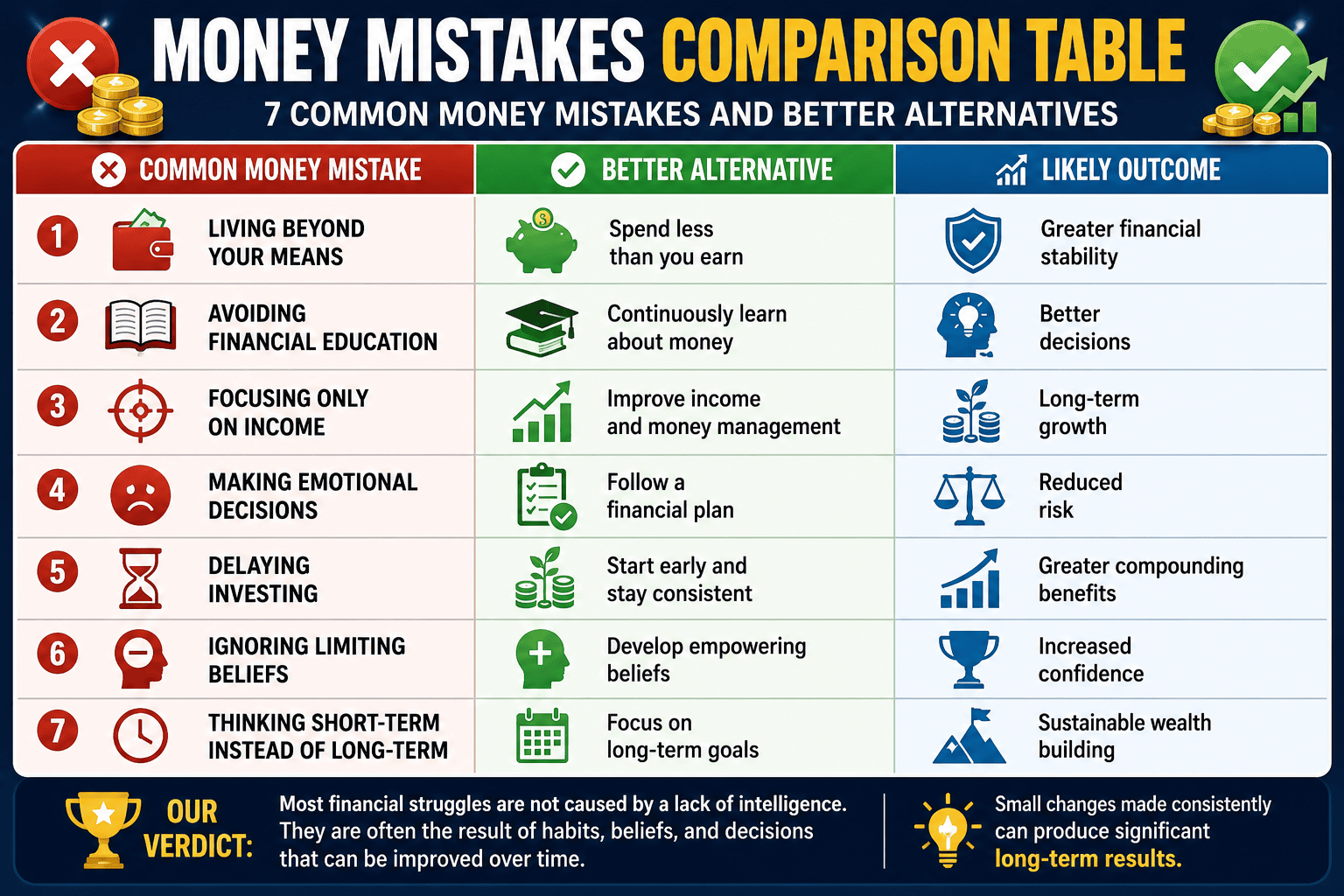
7 Common Money Mistakes That Keep People Broke
1. Living Beyond Their Means
One of the most common financial mistakes is spending more money than is being earned. Lifestyle inflation often occurs when income increases, causing expenses to rise at the same pace.
While enjoying success is important, consistently spending everything that is earned leaves little room for saving, investing, or wealth creation.
Building financial security often requires maintaining a gap between income and expenses.
2. Avoiding Financial Education
Many people spend years developing professional skills but invest very little time learning about personal finance, investing, wealth building, or money management.
Financial education can improve decision-making and help individuals avoid costly mistakes. The more knowledge people gain about money, the better equipped they are to manage and grow it effectively.
Learning about finance is one of the highest-return investments many people can make.
3. Focusing Only on Income
Many people believe that earning more money will automatically solve their financial challenges. While increasing income can certainly help, financial success is often influenced by how money is managed rather than how much is earned.
Some high-income earners struggle financially because their spending rises alongside their income. Others build substantial wealth on moderate incomes through disciplined saving, investing, and long-term planning.
Income is important, but financial habits often determine long-term outcomes.
4. Making Emotional Money Decisions
Emotions can have a significant impact on financial behaviour. Fear, excitement, stress, and impatience often influence spending, investing, and business decisions.
People who make decisions based primarily on emotion may take unnecessary risks or avoid opportunities that could benefit them in the long run.
Developing emotional awareness and following a clear financial plan can help reduce costly mistakes and improve decision-making.
5. Delaying Investing and Wealth Building
Time is one of the most valuable assets in wealth creation. Unfortunately, many people postpone investing because they believe they need more money, more knowledge, or the perfect opportunity before they begin.
The longer individuals wait, the less time they have to benefit from compounding growth and long-term investment strategies.
Starting small is often more effective than waiting for ideal circumstances that may never arrive.
6. Ignoring Limiting Beliefs About Money
Many financial challenges begin with beliefs that operate below conscious awareness. Thoughts such as “I’ll never be wealthy,” “Money is difficult to earn,” or “Successful people are different from me” can influence behaviour without people realising it.
These beliefs may reduce confidence, discourage action, and limit the willingness to pursue opportunities.
Identifying and challenging limiting beliefs is often an important step toward creating healthier financial habits and greater financial success.
7. Thinking Short-Term Instead of Long-Term
Many financial mistakes occur when people focus exclusively on immediate rewards rather than long-term outcomes.
Short-term thinking may encourage unnecessary spending, impulsive decisions, and missed opportunities for saving or investing. In contrast, long-term thinking supports patience, discipline, and sustainable financial growth.
The ability to think beyond immediate circumstances is often one of the key differences between financial struggle and financial success.
Common Money Mistakes vs Better Financial Habits
Many financial problems begin with small daily decisions. Replacing poor money habits with better financial habits can significantly improve long-term financial success.
| Common Money Mistake | Better Financial Habit |
|---|---|
| Spending without a plan | Create and follow a budget |
| Avoiding financial education | Continue learning about money |
| Short-term thinking | Focus on long-term wealth |
| Emotional spending | Make intentional financial decisions |
| Ignoring opportunities | Develop opportunity awareness |
Small financial improvements made consistently over time often create the biggest long-term results.
Money Mistakes Comparison Table
Recommended Resources
Improving your financial habits is a journey that combines learning, self-awareness, and consistent action. The resources below will help you strengthen your financial mindset, avoid costly mistakes, and build long-term wealth.
• How to Remove Money Blocks and Create Financial Success
• Money Processes: 9 Powerful Benefits of Kevin Trudeau’s Live Training
• Kevin Trudeau Money Processes Review: Understanding Money Counter Intentions
• What Is a Wealth Mindset? How to Think Like Wealthy People
• Wealth Consciousness Explained: Why Some People Attract Money More Easily Than Others
• Money Programming Explained: How Your Childhood Beliefs About Money Shape Your Financial Future
Related Money Mindset Articles
• How Your Beliefs Affect Financial Success
• Abundance Mindset vs Scarcity Mindset: Key Differences Explained
• Why Some People Stay Financially Stuck: 9 Hidden Patterns That Keep People Broke
• Financial Self-Sabotage: 9 Powerful Signs Hidden Patterns Are Holding You Back
• 7 Signs Your Money Mindset Is Changing (Even If You Haven’t Made More Money Yet)
Related Kevin Trudeau Programs
• Superpower Processes: 9 Powerful Benefits of Kevin Trudeau’s Live Training
• Accelerator Processes: 9 Powerful Benefits of Kevin Trudeau’s Live Training
• Kevin Trudeau Products: 11 Popular Programs Reviewed in 2026
Additional Learning Resources
External Resources
Why Smart People Still Make Expensive Money Mistakes
One of the biggest misconceptions about financial success is that intelligence alone determines who becomes wealthy. In reality, many highly educated, talented, and hardworking people continue to struggle financially, while others with fewer qualifications build significant wealth over time.
The difference often comes down to behaviour rather than intelligence.
Financial success is influenced by the decisions we make every day. Small choices—such as saving consistently, avoiding unnecessary debt, continuing financial education, and recognising opportunities—can produce significant results over many years.
Many financial experts refer to this as the power of compound habits. Just as compound interest allows money to grow over time, positive financial habits also accumulate. Likewise, poor financial habits tend to compound in the opposite direction, making recovery increasingly difficult if left unchanged.
Understanding this principle helps explain why seemingly small money mistakes can eventually create major financial problems.
Why Financial Awareness Is More Important Than Financial Knowledge
Knowing what to do with money is only one part of the equation.
Many people already understand basic financial principles. They know they should save, invest, reduce unnecessary spending, and plan for the future.
Yet they often fail to follow through.
This is where financial awareness becomes valuable.
Financial awareness involves recognising the thoughts, emotions, and behaviours that influence financial decisions before acting on them.
For example, someone may recognise that they frequently spend money when feeling stressed or anxious.
Another person may notice they avoid looking at their finances because they fear discovering problems.
Others may hesitate to invest in themselves because they worry about failure or believe they are not capable of achieving greater financial success.
Developing greater awareness of these patterns allows people to make more intentional decisions instead of reacting automatically.
Successful People Continue Learning About Money
Financial markets change.
Technology changes.
Business changes.
Opportunities change.
The people who continue improving their financial knowledge often become better equipped to recognise opportunities that others overlook.
This does not necessarily require a university degree.
Many successful entrepreneurs spend time reading books, listening to podcasts, attending seminars, studying investing, improving communication skills, learning marketing, and developing leadership abilities.
They understand that investing in knowledge often creates opportunities that produce returns far beyond the original investment.
Continuous learning also improves confidence.
The more knowledge people gain, the more comfortable they become making financial decisions and evaluating opportunities objectively.
Better Financial Decisions Begin With Better Questions
Rather than asking:
“Can I afford this?”
Successful people often ask:
“Will this decision improve my future?”
Instead of asking:
“How much does this cost?”
They ask:
“What value will this create over time?”
This subtle shift encourages long-term thinking rather than emotional decision-making.
It also helps people evaluate purchases, investments, education, and business opportunities more objectively.
Learning to ask better financial questions can dramatically improve the quality of future decisions.
Small Financial Improvements Create Long-Term Results
Many people believe financial success requires dramatic change.
In reality, lasting wealth is often built through small improvements repeated consistently.
Examples include:
• Saving a small percentage of every income payment.
• Reviewing monthly spending.
• Eliminating unnecessary subscriptions.
• Increasing financial education.
• Investing regularly.
• Building emergency savings.
• Developing additional income streams.
Individually, these actions may appear insignificant.
Together, they can completely transform someone’s financial future over the course of several years.
Financial Confidence Develops Through Action
Confidence rarely appears before action.
More often, confidence grows because of action.
Each positive financial decision reinforces the next one.
Each successful experience increases belief.
Each improvement creates momentum.
Whether someone is beginning to budget, investing for the first time, starting a business, or developing new financial habits, progress usually begins with one intentional decision followed by consistent action.
The goal is not perfection.
The goal is continuous improvement.
Over time, better financial habits become automatic, allowing confidence, opportunity recognition, and long-term wealth creation to grow naturally.
Frequently Asked Questions
Q: Why do smart people struggle financially?
A: Intelligence alone does not guarantee financial success. Habits, beliefs, emotional control, money management skills, and long-term decision-making often play an important role.
Q: What is the biggest money mistake people make?
A: While circumstances vary, living beyond one’s means and failing to plan for the future are among the most common financial mistakes.
Q: Can financial habits be changed?
A: Yes. Through education, awareness, and consistent effort, people can develop healthier financial habits and improve their financial outcomes.
Q: Why is mindset important for financial success?
A: Mindset influences decisions, confidence, risk tolerance, and the willingness to pursue opportunities. These factors can significantly affect financial results over time.
Q: What is the first step toward improving financial habits?
A: The first step is becoming aware of existing habits and identifying areas where small improvements can be made consistently over time.
Avoid Costly Money Mistakes
Final Thoughts
Many people assume that financial struggle is caused by a lack of intelligence, but the reality is often more complex. Financial success is influenced by habits, beliefs, decisions, and the ability to think long-term.
The good news is that most money mistakes can be corrected. Individuals can improve their financial future by developing better habits, increasing financial knowledge, challenging limiting beliefs, and making more intentional decisions.
Small changes made consistently can create significant results over time. Whether the goal is financial security, greater freedom, or long-term wealth creation, progress often begins with a single decision to improve.
Keep learning. Keep growing. Keep moving forward.
And may your future shine as brightly as the flame within you.
Money Habits Self-Assessment
Answer Yes or No.
• Do you regularly plan your spending?
• Do you invest in your financial education?
• Do you make financial decisions based on long-term goals?
• Do you avoid emotional spending?
• Do you regularly look for new financial opportunities?
• Do you review your financial progress?
• Do you believe your financial future can improve?
• Do you consistently develop better money habits?
If you answered “Yes” to four or more questions, you are developing many of the habits associated with long-term financial success. Continue strengthening these habits through learning, awareness, and consistent action.