9 Powerful Relationship Boundaries That Create Respect and Trust

Healthy relationship boundaries create trust, respect, communication, emotional safety, and long-term relationship success. Like a fence protects a garden, boundaries protect what matters most.
Healthy relationships thrive when both people feel respected, valued, supported, and emotionally safe.
One of the most effective ways to create these conditions is through healthy relationship boundaries.
Unfortunately, many people misunderstand boundaries. Some believe boundaries create distance, while others worry that setting boundaries will cause conflict.
In reality, healthy relationship boundaries help prevent misunderstandings, strengthen communication, build trust, and create greater emotional security.
Boundaries are not about controlling other people. They are about clearly communicating needs, expectations, and limits in a respectful way.
This guide explores 9 powerful relationship boundaries that create respect, trust, and healthier relationships.
Table of Contents
What Are Relationship Boundaries?
Relationship boundaries are guidelines that help define what is acceptable, respectful, and healthy within a relationship.
They help people communicate their needs, protect their emotional wellbeing, and maintain mutual respect.
Healthy relationship boundaries create clarity because both people understand expectations and responsibilities.
Rather than restricting relationships, boundaries often strengthen them by reducing confusion, resentment, and unnecessary conflict.
Strong boundaries help create an environment where trust, communication, and emotional connection can grow.
Why Personal Empowerment Matters
Many relationship problems develop when expectations remain unspoken or unclear.
Without healthy boundaries, people may feel overwhelmed, misunderstood, disrespected, or emotionally exhausted.
Relationship boundaries help create emotional safety because they encourage honest communication and mutual understanding.
They also help prevent common relationship challenges such as resentment, poor communication, unhealthy dependence, and repeated misunderstandings.
Healthy boundaries are often one of the strongest foundations of long-term relationship success.
"Healthy boundaries do not push people away—they create the safety that allows love and trust to grow."
Kevin Trudeau's Teaching Tweet
9 Powerful Relationship Boundaries That Create Respect and Trust
1. Honest Communication Boundaries
Healthy relationships depend on open and honest communication.
This means creating an expectation that important conversations will be handled honestly, respectfully, and directly rather than through avoidance, assumptions, or passive-aggressive behaviour.
Honest communication helps prevent misunderstandings and strengthens trust over time.
How to Apply This:
Commit to discussing concerns openly and respectfully rather than allowing frustrations to build silently.
2. Respect Boundaries
Respect is one of the most important ingredients in any healthy relationship.
Respect boundaries help ensure that both people feel valued, heard, and appreciated.
This includes respecting opinions, personal choices, emotions, goals, and individual differences.
How to Apply This:
Treat your partner with the same respect you would expect to receive yourself.
3. Personal Time Boundaries
Spending time together is important, but healthy relationships also allow room for individuality.
Personal time boundaries encourage both people to maintain hobbies, friendships, interests, and activities outside the relationship.
This often leads to greater personal growth and a healthier relationship dynamic.
How to Apply This:
Support each other’s need for occasional personal time without interpreting it as rejection.
4. Conflict Resolution Boundaries
Disagreements are normal, but how conflicts are handled can significantly impact relationship health.
Conflict resolution boundaries establish expectations for respectful discussions even during difficult conversations.
This may include avoiding insults, name-calling, threats, or intentionally hurtful behaviour.
How to Apply This:
Focus on solving problems together rather than trying to win arguments.
5. Privacy Boundaries
Trust and transparency are important in healthy relationships, but so is personal privacy.
Privacy boundaries help both people maintain a sense of individuality while still building trust.
Healthy privacy may include personal journals, private conversations with trusted friends, individual interests, or personal reflection time.
Privacy boundaries are not about secrecy. They are about respecting personal space and maintaining a healthy balance between togetherness and individuality.
How to Apply This:
Discuss expectations around privacy openly and agree on what feels respectful and appropriate for both people.
6. Financial Boundaries
Money is one of the most common sources of relationship conflict.
Financial boundaries help create clarity around spending, saving, debt, financial goals, and shared responsibilities.
When financial expectations remain unclear, misunderstandings and resentment can develop over time.
Healthy financial boundaries encourage transparency, accountability, and teamwork.
How to Apply This:
Discuss financial expectations openly and review shared goals regularly to ensure both people remain aligned.
7. Emotional Boundaries
Emotional boundaries help people take responsibility for their own feelings while still supporting each other.
Healthy relationships involve compassion and empathy, but one person should not feel solely responsible for managing the emotions of the other.
Emotional boundaries encourage personal responsibility, emotional maturity, and healthier communication.
How to Apply This:
Support your partner’s feelings without taking ownership of emotions that belong to them.
8. Digital Boundaries
Technology has created new relationship challenges that previous generations rarely faced.
Digital boundaries help establish expectations around social media, texting, online friendships, device use, and digital communication.
Without clear digital boundaries, misunderstandings, jealousy, and trust issues can sometimes develop.
Healthy digital boundaries promote transparency, trust, and respectful online behaviour.
How to Apply This:
Discuss expectations around social media, online communication, and device use in a way that feels comfortable for both people.
9. Future Goals Boundaries
Healthy relationships benefit when both people understand each other’s goals, priorities, and long-term vision.
Future goals boundaries help prevent misunderstandings related to career ambitions, finances, family plans, lifestyle preferences, and personal development.
While goals may evolve over time, regular communication helps ensure both people continue moving in a compatible direction.
How to Apply This:
Schedule regular conversations about future plans, priorities, and expectations to maintain alignment and mutual understanding.
Examples of Healthy Relationship Boundaries
Healthy boundaries allow both people to feel respected, valued, and emotionally safe while strengthening the relationship.
| Healthy Boundary | Relationship Benefit |
|---|---|
| Honest communication | Builds trust and understanding. |
| Respecting personal space | Supports independence and emotional wellbeing. |
| Discussing expectations | Reduces misunderstandings. |
| Respecting each other’s values | Strengthens mutual respect. |
| Resolving disagreements respectfully | Creates emotional safety. |
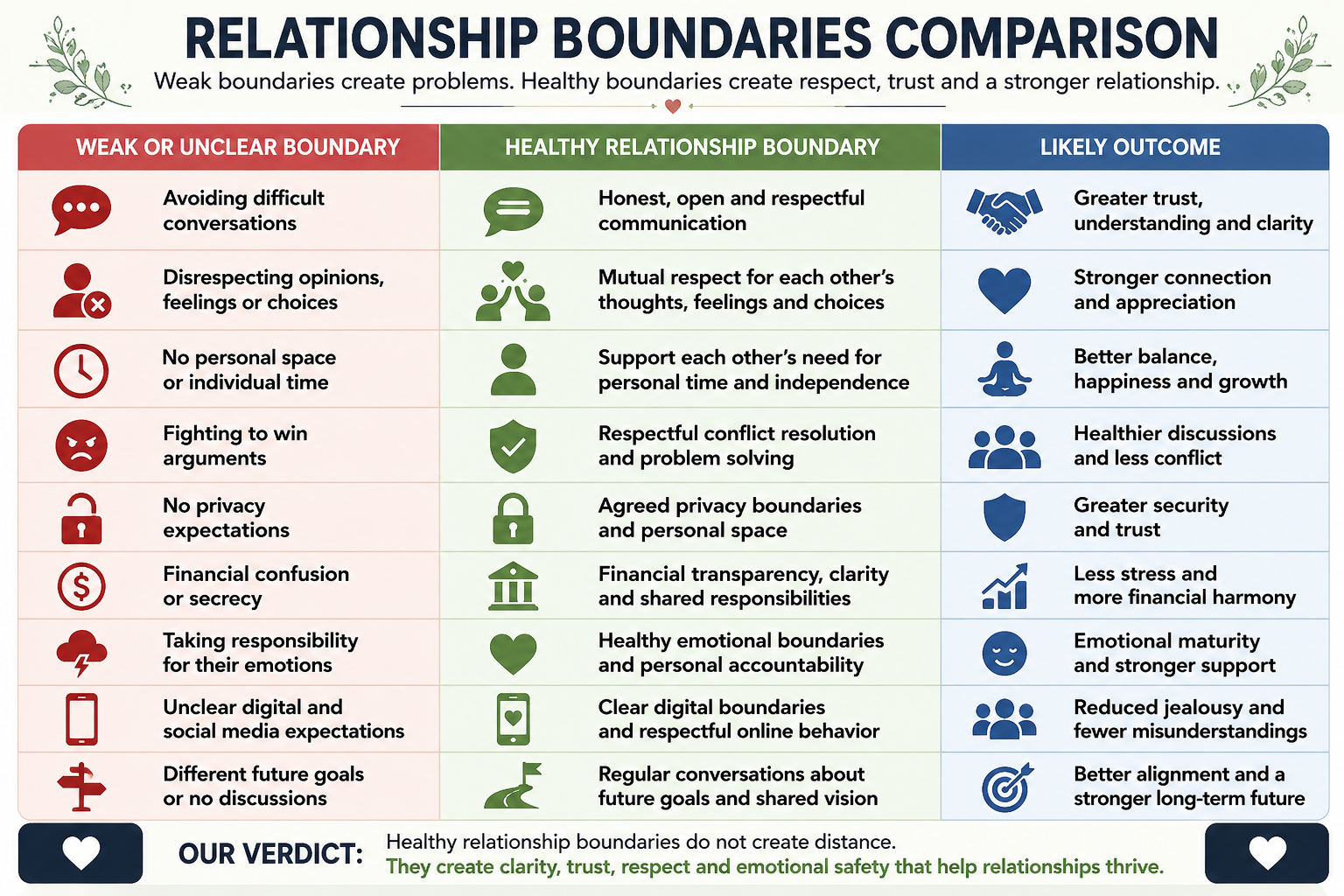
Healthy boundaries are not about creating distance—they create the emotional safety that allows trust, respect, and intimacy to grow.
Warning Signs of Unhealthy Relationship Boundaries
Unhealthy boundaries can create confusion, resentment, and emotional strain.
Common warning signs include:
• Constant feelings of guilt
• Difficulty saying no
• Fear of expressing needs
• Frequent misunderstandings
• Lack of privacy
• Emotional exhaustion
• Feeling controlled or manipulated
• Repeated disrespect for personal limits
Recognising these signs early allows people to strengthen relationship boundaries before larger problems develop.
Healthy relationship boundaries should create greater respect, trust, communication, and emotional safety rather than fear or restriction.
Benefits of Healthy Relationship Boundaries
Many people are surprised to discover that healthy relationship boundaries often bring people closer together.
Benefits may include:
• Stronger trust
• Better communication
• Greater emotional safety
• Reduced conflict
• Increased respect
• Healthier independence
• Stronger emotional connection
• Improved relationship satisfaction
When boundaries are communicated clearly and respected consistently, relationships often become healthier, stronger, and more fulfilling.
Relationship Boundaries Comparison Table
Recommended Resources
Healthy relationship boundaries create trust, respect, emotional safety, and stronger communication. The resources below will help you strengthen your relationship while developing healthier boundaries and deeper emotional connection.
• Relationship Processes Review: Can Relationship Counter Intentions Affect Love and Connection?
• 13 Signs of a Healthy Relationship (And How to Build One)
• 13 Trust-Building Habits That Strengthen Relationships
• 11 Relationship Habits That Build Trust and Strengthen Connection
• 9 Communication Mistakes That Damage Relationships (And How to Fix Them)
• 15 Powerful Ways to Build Emotional Connection in a Relationship
• 9 Powerful Ways to Rebuild Trust After It Has Been Broken
Related Relationship Articles
• 11 Powerful Reasons Relationships Fail (And How to Avoid Them)
• 11 Powerful Ways to Forgive and Move Forward in a Relationship
Related Personal Growth Articles
• How to Build Self-Confidence Naturally: 10 Proven Strategies for Personal Growth
• What Is Personal Empowerment? 7 Ways to Take Control of Your Life
• How to Build Personal Power: 9 Practical Ways to Feel More Confident and in Control
• 7 Proven Strategies for Overcoming Limiting Beliefs and Personal Growth
Related Kevin Trudeau Programs
• Superpower Processes: 9 Powerful Benefits of Kevin Trudeau’s Live Training
• Money Processes: 9 Powerful Benefits of Kevin Trudeau’s Live Training
• Kevin Trudeau Products: 11 Popular Programs Reviewed in 2026
Additional Learning Resources
External Resources
Frequently Asked Questions
Q: What are relationship boundaries?
A: Relationship boundaries are guidelines that help define what is acceptable, respectful, and healthy within a relationship. They help create trust, communication, emotional safety, and mutual respect.
Q: Are boundaries controlling?
A: No. Healthy relationship boundaries are not about controlling another person. They are about clearly communicating needs, expectations, and limits in a respectful way.
Q: Why are boundaries important in relationships?
A: Boundaries help prevent misunderstandings, reduce resentment, improve communication, strengthen trust, and create healthier relationships.
Q: What are examples of healthy boundaries?
A: Examples include honest communication, mutual respect, personal time, privacy expectations, emotional boundaries, financial boundaries, and digital boundaries.
Q: Can boundaries strengthen a relationship?
A: Yes. Healthy boundaries often improve trust, communication, emotional safety, respect, and long-term relationship satisfaction.
Build Healthy Relationship Boundaries
Need a Flexible Payment Option?
Many participants choose a payment plan so they can begin strengthening their relationships sooner. Explore the available payment options and choose the option that best supports your journey toward healthier communication, stronger boundaries, and lasting trust.
Final Thoughts
Healthy relationship boundaries are one of the most powerful tools for creating trust, respect, communication, and emotional safety.
Many relationship problems develop when expectations remain unclear or personal limits are not respected. Strong boundaries help prevent these challenges before they become larger issues.
Rather than creating distance, healthy relationship boundaries often bring people closer together because they encourage honesty, mutual understanding, accountability, and respect.
By establishing healthy communication, emotional, financial, privacy, and future-planning boundaries, couples can create stronger relationships that are built on trust and shared understanding.
Healthy relationships do not happen by accident.
They grow through intentional choices.
They thrive through mutual respect.
And they become stronger when both people work together to protect what they are building.
Strong boundaries create strong relationships.
Relationship Boundaries Self-Assessment
Answer Yes or No.
• Do you communicate your needs honestly?
• Do you respect your partner’s personal space?
• Do you feel emotionally safe expressing yourself?
• Do you both respect each other’s opinions?
• Can you say “no” without fear?
• Do you resolve disagreements respectfully?
• Do your boundaries strengthen trust rather than create distance?
• Are you both committed to maintaining healthy relationship habits?
If you answered “Yes” to four or more questions, your relationship demonstrates many of the healthy boundaries that support trust, respect, emotional safety, and long-term relationship success.